

Introduction: The Double-Edged Sword of Intensity
In the bio-hacking and fitness world, “Cortisol” has become a dirty word. It’s often blamed for everything from stubborn belly fat to brain fog and poor sleep. But here is the truth that most influencers won’t tell you: You cannot get stronger, faster, or leaner without Cortisol.
Cortisol is your body’s primary “Survival Signal.” During a high-intensity workout, a spike in cortisol is exactly what you want—it mobilizes glucose for energy, increases heart rate, and sharpens focus. The problem isn’t the spike; it’s the leak.
In simple terms, training for stress means learning how to exercise without pushing your body into constant overload.
Exercise is a form of stress, and your body reacts to it just like it reacts to work pressure, lack of sleep, or emotional tension.
Most people don’t realize:
- not all workouts reduce stress immediately
- intense exercise can temporarily increase stress hormones
- recovery is just as important as training itself
👉 The goal is balance, not avoiding stress completely.
When your body stays in a high-cortisol state long after your workout is over, you stop building muscle and start breaking down. In 2026, the goal isn’t to avoid stress—it’s to become a “Master of the Pivot,” training your nervous system to switch from “Fight or Flight” to “Rest and Digest” the second your workout ends.

THE PROBLEM: The Cortisol “Crossover” Effect
The “Modern Mismatch” is that we layer high-intensity training on top of high-intensity lives. If you have a stressful job, poor sleep, and then hit a 5:00 AM HIIT class on an empty stomach, you aren’t “training”—you are redlining your adrenal system.
The Reality: Chronic cortisol elevation leads to Metabolic Resistance. Your body becomes “brittle.” You might be working out harder than ever, but you’re seeing:
Immune Suppression: You find yourself catching every cold that goes around.
Visceral Fat Accumulation: Cortisol tells the body to protect the organs by storing fat in the abdomen.
Muscle Wasting: High cortisol is catabolic, meaning it breaks down muscle tissue for quick energy.
Research from the National Institutes of Health suggests that while short bursts of cortisol are healthy, chronic elevation leads to muscle protein breakdown and suppressed immunity.
What this means in real life:
When cortisol rises too often from poor training balance, people usually feel:
- tired even after workouts
- low motivation on rest days
- poor sleep after intense sessions
- “wired but exhausted” feeling
👉 This is not fitness failure — it’s a recovery imbalance.
THE WHAT: Understanding the HPA Axis
Cortisol follows a circadian rhythm. It should be highest in the morning (to wake you up) and lowest at night (to let you sleep).
- The Acute Spike: This happens during your Loaded Carries or sprints. It’s healthy and necessary for adaptation.
- The Chronic Plateau: This happens when your Wearable Data shows a low HRV and a high resting heart rate all day. This is the “Red Zone” we need to fix.
As a Lab Tech, I explain to my clients that cortisol is “catabolic”—it breaks things down. To stay “anabolic” (building muscle), you must signal your nervous system to exit the stress state as soon as the workout ends. This aligns with modern evidence linking hormonal balance to long-term physical resilience.
THE COMMON MISTAKES: Why Your Recovery is Failing
1. Training Fasted Every Time
While intermittent fasting has benefits for insulin sensitivity, doing high-intensity intervals on zero fuel is a massive cortisol trigger. If the body thinks it’s starving and running from a predator (the workout), cortisol will skyrocket.
2. Excessive Caffeine Intake
Caffeine mimics the stress response. If you are drinking three cups of coffee and then taking a high-stimulant pre-workout, you are effectively “borrowing” energy from your adrenals that you will have to pay back with interest later.
3. Skipping the “Cool Down”
Walking out of a high-intensity class and immediately jumping into your car to fight traffic is a recipe for chronic stress. Your nervous system needs a “bridge” back to safety.
THE SOLUTION: The 2026 “Train Hard, Recover Smarter” Strategy
To upgrade your stress tolerance, we have to move beyond the “rest day” mentality. In 2026, recovery is an active, aggressive pursuit. We use a three-pronged recovery attack to ensure that the cortisol spike from your workout doesn’t become a permanent metabolic resident.
Pillar 1: Nutrient Signaling (Turning Off the Alarm)
The Concept: Nutrients are more than just calories; they are information. When you finish a high-intensity session, your body is in a “depletion” state, which signals the adrenals to keep pumping out cortisol to mobilize more energy. We use specific “Nutrient Signals” to tell the brain the crisis is over.
- The Carbohydrate “Insulin Brake”: Cortisol and Insulin have an antagonistic relationship. When insulin rises, cortisol typically falls. By consuming a targeted amount of fast-acting, whole-food carbohydrates (like a sweet potato, white rice, or fruit) within 45 minutes of a workout, you signal to your system that “fuel is back in the tank.” This effectively shuts off the emergency cortisol response.
- The Mineral Buffer (Magnesium & Sodium): Intense training depletes electrolytes, specifically Magnesium. Since Magnesium is the “off-switch” for the nervous system, a deficiency keeps you in a “wired” state. We use a “Mineral Cocktail” post-workout (sea salt, potassium, and magnesium malate) to restore the electrical balance of the cell and lower the heart rate.
The Action: Never finish a HIIT session and wait three hours to eat. Use a “Post-Workout Window” of 30–60 minutes to deliver a 2:1 ratio of carbs to protein.
Pillar 2: Neurological Swapping (The Vagal Flip)
The Concept: You cannot think your way out of a stress response; you have to breathe your way out. Pillar 2 uses Vagus Nerve Stimulation (VNS) to manually flip the switch from the Sympathetic (Fight or Flight) nervous system to the Parasympathetic (Rest and Digest).
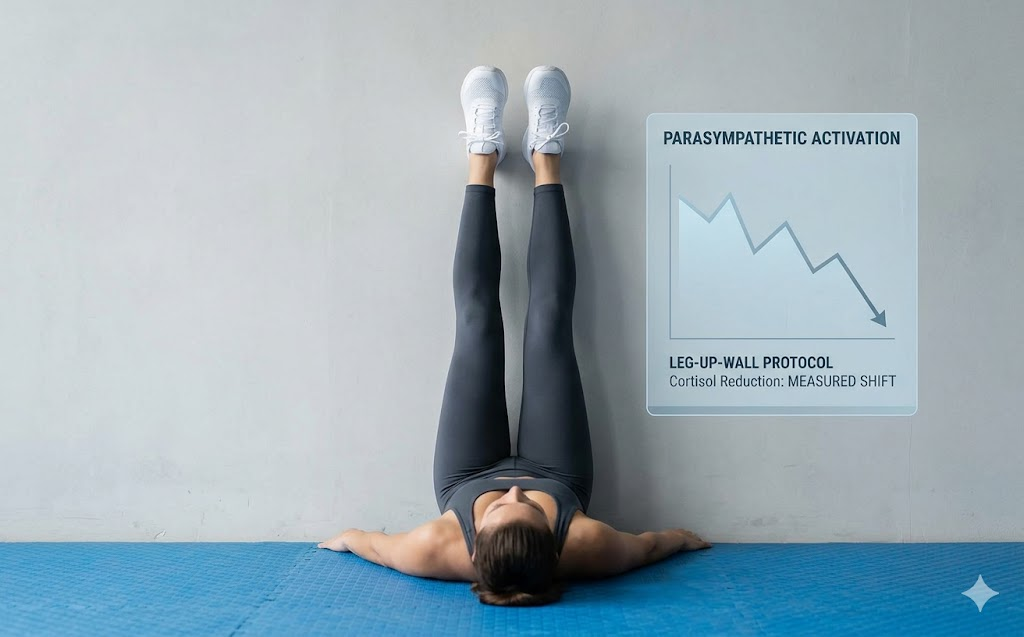
- The 5-Minute “Locker Room” Protocol: Immediately after your last set, before checking your phone, lie on your back with your legs elevated against a wall. This position (Viparita Karani) encourages blood flow back to the heart and triggers the baroreceptors that stimulate the Vagus nerve.
- Exhalatory Loading: Perform “Box Breathing” (4s inhale, 4s hold, 8s exhale, 4s hold). The elongated exhale is the secret. It physically slows the sinoatrial node of the heart.
- The Cold Water Reset: Splashing freezing water on your face or submerged your forearms in cold water for 60 seconds triggers the “Mammalian Dive Reflex,” which causes an immediate drop in heart rate and a surge in vagal tone.
The Why: This “Neural Swap” ensures that the stress of the gym stays in the gym. It prevents the “spillover” that causes irritability and brain fog during your workday.
Pillar 3: Adaptive Periodization (Intensity Matching)
The Concept: The biggest mistake of the Stalled Optimizer is following a rigid program regardless of how they slept or felt that morning. Adaptive Periodization means your workout intensity is a slave to your recovery capacity, not the other way around.
- The “Green-Yellow-Red” System: We use Wearable Mastery to dictate the day’s load.
- Green Day (High HRV): Hit your high-intensity intervals or heavy PRs. Your body has the “budget” for the cortisol spike.
- Yellow Day (Baseline HRV): Stick to moderate lifting or “Zone 2” cardio. Maintain the habit without overdrawing the account.
- Red Day (Low HRV/High RHR): Cancel the HIIT. Swap it for Neuro Fitness Drills or a long, 10-minute post-meal walk.
- The “Autoregulation” Rule: If you are 10 minutes into a workout and your “pop” isn’t there, you pivot. Forcing a high-intensity session on a low-recovery body is the fastest way to spike visceral fat and trigger burnout.
The Goal: By matching the stimulus to the current state of your biology, you ensure that every workout results in Adaptation rather than Accumulated Stress.
SYNERGY: Closing the Loop
When you combine these three pillars, you create a “Metabolic Buffer.”
- You signal the end of stress with nutrients (Pillar 1).
- You force the nervous system to relax with breathwork (Pillar 2).
- You protect the system from overload by using data (Pillar 3).
This is how you train like an elite athlete in 2026. You aren’t just “working out”; you are managing a high-performance biological system. By mastering these pillars, you support your AMPK vs mTOR signaling, ensuring you stay in a “Growth” state more often than a “Survival” state.
[Image Placeholder: A “Recovery Pyramid” showing Sleep at the base, followed by Nutrient Signaling, and Vagal Tone at the peak]
Common Mistake: Thinking that Pillar 2 can fix a total lack of Pillar 1. If you breathe deeply but never eat, your blood sugar remains low and cortisol will remain high. You must execute all three pillars to achieve the “Metabolic Warrior” status.

THE HOW: The Stress-Intensity Management Table
| Training Phase | Action | Neural Effect | Clinical Objective |
| Warm-Up | Mobility Flow | Joint Lubrication | Signal “Safety” to the brain. |
| Work Sets | Explosive Effort | Adrenaline Spike | Maximize power and glucose use. |
| Rest Gaps | Nasal Breathing | Vagus Nerve Tone | Prevent cortisol from redlining. |
| Cool-Down | Legs Up Wall | Parasympathetic Shift | Jumpstart the recovery process. |
CASE STUDIES: From Burnout to Balance
The following examples represent the “Modern Mismatch” we see in high-performers today. These individuals weren’t lacking willpower; they were lacking a Recovery Signal.
Case Study 1: The “HIIT-Only” Athlete (The Cortisol Paradox)
The Problem: Karen, a 38-year-old marketing executive, felt she had to “earn her food” through intensity. She performed high-intensity interval training (HIIT) 6 days a week, often in a fasted state. Despite her discipline and a “clean” low-carb diet, she was experiencing a metabolic plateau.
- The Symptoms: She was “wired but tired”—exhausted all day but unable to fall asleep at night. Most frustratingly, her visceral fat was increasing, giving her a “puffy” midsection that didn’t match her effort.
- The Biology: Karen was stuck in a chronic AMPK-dominant state. By training HIIT every day without carbs, her cortisol was permanently elevated, telling her body to store fat for a “crisis” and break down muscle for quick glucose.
The Solution: We implemented a “Metabolic Pivot.”
- Reduced Intensity: We slashed her HIIT sessions to just 2 days a week to allow her adrenals to recover.
- Cognitive Integration: We added 3 days of Neuro Fitness Drills (like the “Subtract-7 Walk”). This provided a low-intensity stimulus that improved her brain function without spiking her stress hormones.
- Nutrient Signaling: We introduced a “Refeed” of 40g of complex carbohydrates immediately post-workout to “brake” the cortisol response.
The Result: Within 48 hours, Karen reported her first full night of sleep in months. Because her cortisol dropped, her body stopped hoarding water and fat in her midsection. She lost 3 inches from her waist in 30 days while actually exercising less.
Case Study 2: The Stressed Professional (The Sympathetic Spillover)
The Problem: Mark, a 45-year-old attorney, used heavy, high-intensity lifting as his “stress relief” after 10-hour workdays. While he was physically strong, he noticed a disturbing trend: he was bringing the “aggression” of the gym home to his family.
- The Symptoms: Chronic irritability, a high resting heart rate, and an inability to “wind down” in the evening.
- The Biology: Mark was moving from a high-stress office to a high-stress gym environment. His nervous system never left the Sympathetic (Fight or Flight) state. To his brain, a heavy deadlift and a courtroom battle looked identical. He was suffering from “Sympathetic Spillover,” where the stress of training was compounding his work stress rather than relieving it.
The Solution: We implemented a “Vagal Bridge.”
- The Locker Room Protocol: Before checking his phone or leaving the gym, Mark committed to 10 minutes of Box Breathing (4-4-8-4) while lying on the floor with his legs up the wall.
- The Data Audit: He began using Wearable Tracking to monitor his HRV. If his morning HRV was in the “Red,” he swapped his heavy lifting for a 10-minute post-meal walk.
The Result: Mark’s HRV increased by an average of 15 points within two weeks. By manually “flipping the switch” to a parasympathetic state before leaving the gym, his “work-to-home” transition became seamless. He found he could be a “Warrior” in the gym and a “Nurturer” at home, simply by mastering his neurological recovery.
What We Can Learn from Karen and Mark
The takeaway here is that more is not better; better is better. * Karen learned that Nutrient Signaling is required to turn off the fat-storage alarm.
- Mark learned that Neurological Swapping is required to protect your personality from your training intensity.
Both achieved a “Metabolic Reset” not by working harder, but by respecting the AMPK vs mTOR balance. If you feel like your progress has stalled despite your hard work, you are likely missing one of these two recovery signals.
THE RESULTS: What You Can Expect
- Immediately: Reduced post-workout “jitters” and better mental clarity.
- Days 14–21: Improved sleep quality and faster muscle recovery.
- Day 30+: Improved hormonal efficiency over time, leading to better body composition and reduced visceral fat.
THE TECHNICAL WHY: The Biology of the “Switch”
We want to train your body to move from the Sympathetic (Stress) state to the Parasympathetic (Recovery) state as fast as possible. This “switching speed” is the ultimate marker of fitness.
When you use 10-minute post-meal walks, you aren’t just clearing glucose; you are telling your brain that resources are plentiful and the “threat” is gone. This allows your body to enter mTOR (Growth) mode instead of staying in AMPK (Repair/Stress) mode indefinitely.
FAQ
Should I stop doing HIIT if my cortisol is high?
No, but you should reduce the frequency. If you are chronically stressed, move to 1–2 days of HIIT and 3 days of heavy, slow strength training.
Does cold exposure help or hurt cortisol?
In the short term, a cold plunge is a stressor (it spikes cortisol). However, the rebound effect after you get out is a powerful parasympathetic trigger. Don’t cold plunge immediately after a strength workout, as it can blunt muscle growth.
What are the “Red Flags” of high cortisol? If you are waking up at 3:00 AM with a racing mind, seeing a “puffy” face in the morning, or losing your “pump” during workouts, your cortisol is likely chronically elevated
FINAL TAKEAWAY: Train Like an Athlete, Recover Like a Pro
You don’t have to choose between high-intensity training and healthy cortisol levels. You just have to be more disciplined with your recovery than you are with your work.
Stop “grinding” and start signaling. Use your wearable data to tell you when to push and when to pull back. When you master the stress response, you stop being a Stalled Optimizer and become a true Metabolic Warrior.
If your goal is to train without overloading stress:
- don’t do high intensity every day
- mix hard and easy sessions
- prioritize sleep and recovery days
- reduce workout intensity when stress is already high
👉 Fitness improves when stress is managed, not maximized.
Ready to identify your specific stress bottleneck? Take our 2-Minute Bio-Recovery Audit to see where your recovery is leaking.
Disclaimer: The information provided in this post is for educational purposes only. Chronic stress and adrenal fatigue can be symptoms of underlying medical conditions. If you are experiencing extreme fatigue or hormonal imbalances, consult with a physician. Use of these protocols is at your own risk.
Next Step: Find Your Metabolic Bottleneck
Are you a Stalled Optimizer or a Metabolic Warrior? Stop guessing and start signaling.
To find out which of your 4 biological pillars is stalling your progress, take our 2-minute diagnostic:
Take the 2026 Bio-Recovery AuditDiscover your score across the 4 Pillars of Performance: Engine, Armor, Cleanup, and Repair.