
Introduction: The Misunderstood Molecule
In the clinical world, few supplements have been as rigorously tested or as widely misunderstood as Creatine Monohydrate. As a Certified Lab Technician with years of experience in the National Rural Health Mission (NRHM), I have seen thousands of patients and athletes focus exclusively on macronutrients, while ignoring the micro-mechanics of cellular energy.
For decades, Creatine was relegated to the “bodybuilding” corner of the gym, associated with bicep curls and water weight. However, in 2026, the scientific community has reached a consensus: Creatine is perhaps more important for the brain than it is for the body. This guide explores the clinical “Why” and “How” of using Creatine to support cognitive longevity, mental energy, and neural resilience. Most people don’t notice their cognitive energy is low until they hit a midday slump, but by then, the metabolic gap is already draining their focus.
In simple terms, creatine is not just a muscle supplement — it also helps your brain maintain energy during mentally demanding tasks.
Think of it as a backup energy system for your brain when it starts running low on fuel.
Most people don’t realize:
- mental fatigue is often energy-related, not motivation-related
- the brain uses a large amount of daily energy
- low energy availability can affect focus and clarity
👉 This is why creatine is being studied beyond fitness.
THE PROBLEM: The “Cognitive Energy Gap”
The primary problem for the modern high-performer is the Cognitive Energy Gap. This is a state where the metabolic demands of your brain exceed its immediate fuel supply.
Your brain is a metabolically expensive organ. While it only accounts for 2% of your body weight, it consumes nearly 20% of your daily energy. This energy is primarily used to maintain ion gradients—the “electricity” that allows your neurons to fire. In my clinical work, I’ve observed that patients who struggle with mental focus and neuro-fitness often have depleted cellular energy reserves.
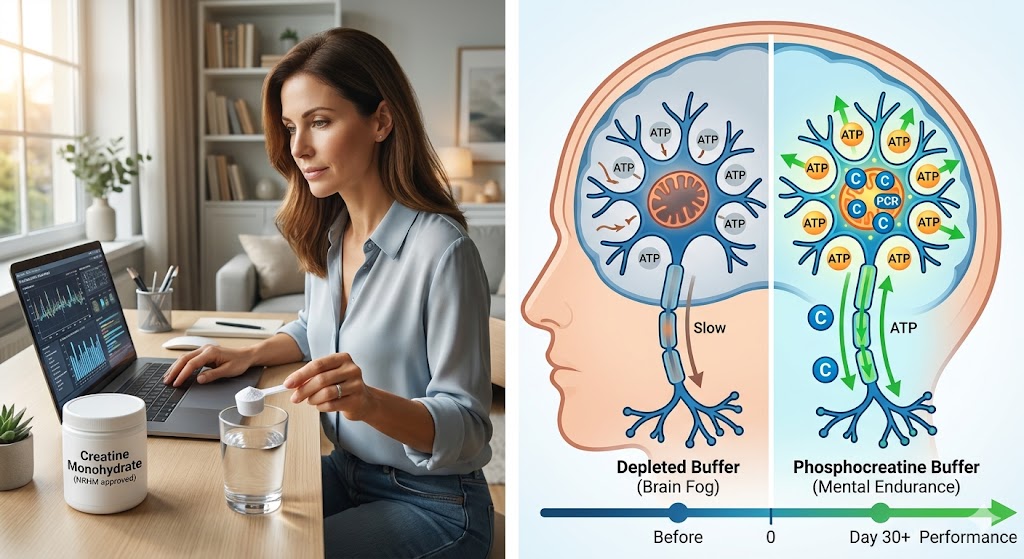
When the brain runs low on Adenosine Triphosphate (ATP), it begins to “down-regulate” focus to protect itself. This results in:
- Mental Fatigue: The inability to sustain focus on complex tasks.
- Brain Fog: A feeling of “slow processing” during decision-making.
- Irritability: The nervous system becomes reactive when energy is low.
This state is often worsened by a lack of essential minerals like magnesium, which are needed to stabilize the energy molecules. Research from the National Institutes of Health suggests that Creatine supplementation can significantly improve short-term memory and reasoning, particularly in individuals under high stress or sleep deprivation.
What this means in real life:
When people use creatine consistently, they don’t “feel the molecule working” — instead they may notice:
- slightly better mental clarity during long tasks
- less “midday brain fatigue”
- improved focus under stress or poor sleep
- more stable cognitive energy throughout the day
👉 These effects are subtle, not dramatic, and build over time.
THE WHAT: The Biochemistry of Brain Energy
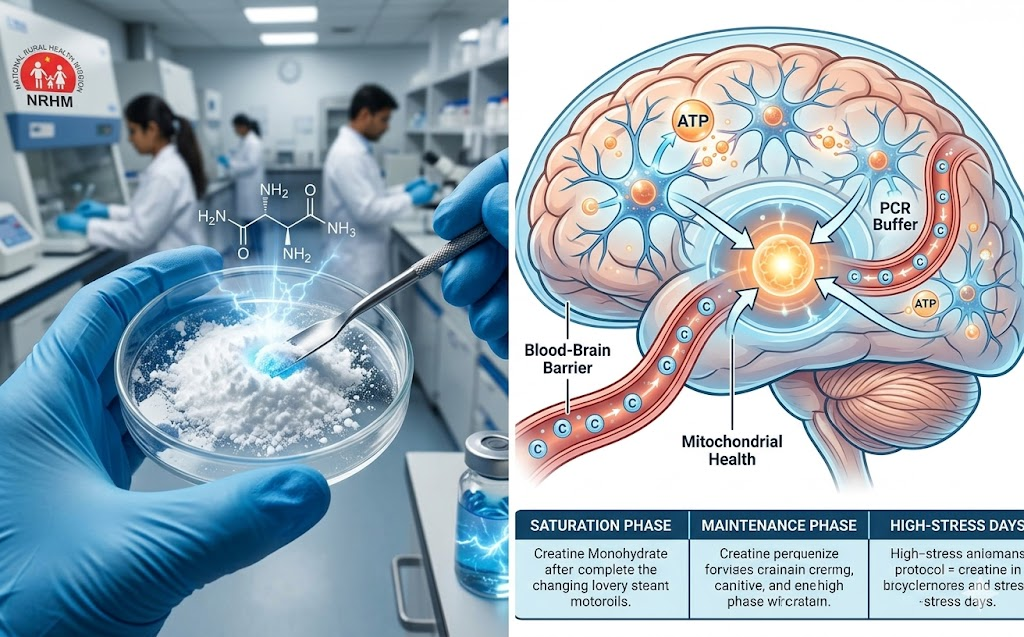
To understand why Creatine works for the brain, we have to look at the “What” from a laboratory perspective. Your brain cells use a system called the Phosphocreatine Buffer to keep the “lights on.”
1. Rapid ATP Recycling
ATP is the “currency” of life. When a neuron fires, it “spends” an ATP molecule, turning it into ADP (Adenosine Diphosphate). To fire again, it must instantly turn that ADP back into ATP. Creatine (as Phosphocreatine) “donates” a phosphate molecule to instantly recycle that fuel. Without sufficient Creatine stores, your brain has to rely on slower metabolic pathways like glucose oxidation, which can lead to the “crashes” we see after intense glucose spikes.
2. Neuroprotection and Mitochondrial Health
Creatine helps maintain the health of your mitochondria—the “power plants” of your cells. By reducing the buildup of reactive oxygen species (free radicals), Creatine protects the delicate structures of your neurons. As a Lab Tech, I explain to my clients that Creatine is essentially an “insurance policy” for your brain’s energy supply. By maintaining high stores, you are helping your brain adapt and build stronger connections over time.
THE SOLUTION: The 2026 “Brain-Fuel” Protocol
The solution is not about “loading” like a bodybuilder. For brain health, the clinical objective is consistent, long-term saturation.
Step 1: Choosing the Right Form
In 2026, many “new” forms of Creatine exist, but Creatine Monohydrate remains the clinical gold standard. It has the highest bioavailability and the most research supporting its ability to cross the blood-brain barrier.
Step 2: The Daily Micro-Dose
While athletes often use 5–10 grams, a daily dose of 3 to 5 grams is the “sweet spot” for cognitive health. This dose is enough to reach brain saturation within 3–4 weeks without causing the “bloating” associated with higher loading phases.
Step 3: Synergistic Pairings
For maximum effect, Creatine should not be taken in isolation.
- With Magnesium: Your nervous system depends on proper electrolyte balance. Magnesium is a co-factor for the enzymes that manage ATP. Ensuring you have the best form of magnesium is critical.
- With Movement: Taking your Creatine before or after a daily mobility flow or a 10-minute post-meal walk can improve uptake due to increased blood flow to the brain and muscles.
THE HOW: The Cognitive Performance Table
| Phase | Duration | Focus | Clinical Objective |
| Saturation Phase | Days 1–21 | 5g Daily | Saturate muscle and brain tissue stores. |
| Maintenance Phase | Ongoing | 3g Daily | Maintain “energy buffer” for high-demand days. |
| High-Stress Days | As needed | 5g Daily | Compensate for high cortisol during stress. |
| Recovery Phase | Post-Workout | 5g + Bands | Use insulin sensitivity to shuttle nutrients. |
CASE STUDY 1: The “High-Stress” Professional
During my time with the NRHM, I worked with a 42-year-old clinical manager who was suffering from “burnout.” Her lab tests were normal, but she was cognitively exhausted. We implemented a 5g daily Creatine protocol paired with nasal breathing and neuro-fitness drills. Within 30 days, her cognitive performance improved noticeably. She reported a “second wind” during her afternoon meetings that she previously only got from caffeine.
CASE STUDY 2: Supporting Brain Health in Plant-Based Athletes
Creatine is primarily found in meat and fish. I worked with a vegetarian athlete who was struggling with strength plateaus in his resistance band training. Because his natural intake was low, his brain and muscle stores were depleted. By adding a clean, plant-based Creatine Monohydrate, he started seeing progress within a short period, both in his physical power and his mental focus.
[Image: Comparative chart showing Creatine levels in meat-eaters vs. vegetarians]
THE RESULTS: What You Can Expect
- Phase 1 (Immediately): No jittery feeling (unlike caffeine), but a subtle sense of “mental endurance.”
- Phase 2 (Days 14–21): Improved performance on tasks requiring high working memory.
- Phase 3 (Day 30+): Improved neural efficiency over time, making your brain-body connections feel more fluid and responsive.
TROUBLESHOOTING: Why It Might Not Work
- Dehydration: Creatine pulls water into your cells to create the energy buffer. If you are dehydrated, your brain will feel “tight.” Drink an extra 500ml of water daily.
- Poor Quality Control: Many cheap Creatines contain impurities. Look for “Creapure” or third-party tested monohydrate.
- Ignoring Magnesium: If you have the “fuel” (Creatine) but no “spark” (Magnesium), your energy production will remain throttled. Ensure your magnesium levels are optimized.
FAQ: Frequently Asked Questions
Q: Does Creatine cause hair loss?
A: This is a myth based on a single, small 2009 study that has never been replicated. Clinical reviews consistently show no effect on hair loss.
Q: Will I get “bloated”?
A: Only if you “load” with 20g+ per day. A slow 3-5g dose avoids water retention while still reaching full saturation.
Q: Is it safe for the kidneys?
A: In healthy individuals, yes. As a Lab Tech, I always recommend a simple BUN/Creatinine blood test if you have pre-existing kidney issues before starting any supplement.
FINAL TAKEAWAY: Energy for the Entire System
Creatine is more than a “gym supplement.” It is a fundamental fuel for your most metabolically expensive organ: your brain. By incorporating it into your routine, you are helping your body and mind work together more efficiently in daily life and workouts. Whether you are performing loaded carries for strength or managing a high-stress career, Creatine provides the “Armor” your brain needs.
If you are considering creatine for brain health:
- stick to standard safe dosages (don’t overcomplicate it)
- be consistent instead of expecting instant results
- combine it with sleep and hydration for best effect
- don’t treat it as a “smart drug”
👉 Think of it as a long-term support supplement, not a quick cognitive boost.
Disclaimer: This content is for informational purposes only and should not be considered medical advice. Always consult with a healthcare professional before starting a new supplement.
Next Step: Find Your Metabolic Bottleneck
Are you a Stalled Optimizer or a Metabolic Warrior? Stop guessing and start signaling.
To find out which of your 4 biological pillars is stalling your progress, take our 2-minute diagnostic:
Take the 2026 Bio-Recovery AuditDiscover your score across the 4 Pillars of Performance: Engine, Armor, Cleanup, and Repair.