

Introduction: The Biology of the “Hidden” Fat
Visceral Fat Loss: In my seven years with the National Rural Health Mission (NRHM), I’ve seen that weight loss is often misunderstood as a battle against the “pinchable” fat under the skin. However, as a Certified Lab Technician, I view visceral fat—the deep abdominal fat surrounding your liver, kidneys, and intestines—as a metabolic emergency. Unlike regular fat, visceral adipose tissue acts as an active endocrine organ, secreting inflammatory cytokines into your portal vein. To lose this fat in 2026, we must move beyond simple calorie counting and focus on the biochemistry of your hormones. This guide provides a clinical blueprint to shrink internal fat and restore your long-term metabolic health.
One important thing I’ve noticed in real-world health settings is that visceral fat is not just a “diet issue.” It is closely linked with daily lifestyle patterns like stress, sleep quality, and even how consistently a person moves throughout the day. Many people don’t realize that even if weight looks normal, visceral fat can still be elevated internally and affect long-term metabolic health.
Unlike subcutaneous fat (the fat under the skin), visceral fat behaves more like an active organ. It can influence inflammation levels in the body and affect how efficiently your metabolism functions. This is why reducing it often improves energy, digestion, and overall recovery—not just appearance.
🧠 What Is Visceral Fat?
Visceral fat is a type of body fat located deep within the abdominal cavity around internal organs.
Unlike subcutaneous fat, which sits beneath the skin, visceral fat surrounds organs such as:
- The liver
- The intestines
- The pancreas
Everyone has some visceral fat, but excessive amounts may be associated with increased health risks.
THE PROBLEM: Why “Dieting” Often Fails Visceral Fat
The primary issue with visceral fat is that it is often invisible. You can have a normal BMI and still be “Skinny Fat,” harboring dangerous levels of internal organ fat. This deep fat is highly inflammatory and directly linked to insulin resistance and heart disease. According to the CDC’s report on metabolic syndrome, abdominal obesity is a leading driver of global health crises. In my Corporate Wellness work, I’ve noticed that high-stress professionals are particularly susceptible, as their bodies use visceral fat as a “storage depot” for stress-related energy. This fat doesn’t just sit there; it actively poisons your metabolism from the inside out.
👉 Add:
Instead of focusing on “perfect diets,” most people see better results by focusing on food quality and portion awareness. Simple improvements like increasing protein intake and reducing ultra-processed foods create a more stable metabolic environment.
The Solution Gap:
Visceral fat is highly sensitive to stress hormones. In my Corporate Wellness work, I see high-performers who eat “clean” but can’t lose their gut because their cortisol is constantly elevated. If you only focus on calories and ignore the AMPK-repair signaling, your body will keep the visceral fat as a “stress reservoir.” According to the CDC’s report on metabolic syndrome, this internal fat is the leading driver of Type 2 Diabetes and heart disease.
⚠️ A Common Misconception About Visceral Fat
Many people believe specific exercises, supplements, or “fat-burning protocols” can target visceral fat directly.
Current evidence suggests there is no proven way to selectively reduce visceral fat alone.
Instead, reductions typically occur through broader lifestyle habits that support overall weight management and metabolic health.
THE WHAT: The Biochemistry of Lipolysis
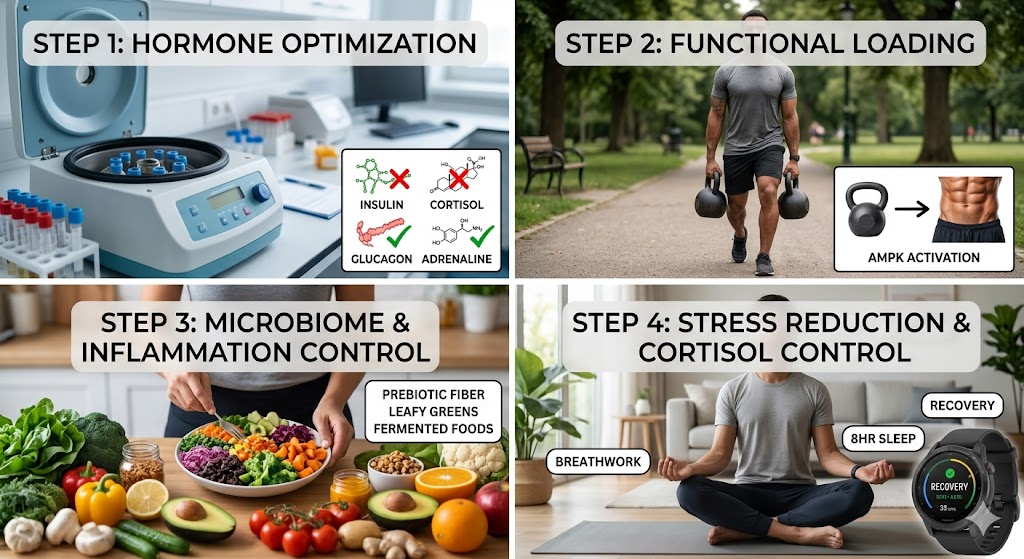
As a Lab Tech, I explain to my clients that visceral fat loss requires a process called Lipolysis. This is the chemical breakdown of triglycerides into glycerol and free fatty acids. For this to happen, the ratio of Insulin to Glucagon must be perfectly balanced. If insulin is high, the “doors” to your fat cells are locked. To unlock them, you must activate the AMPK pathway, which signals the body to stop storing energy and start burning it. Without this biological shift, even the hardest workouts will fail to touch the deep abdominal stores.
THE WHY: The Cortisol-Midsection Connection
One of the biggest reasons people fail to lose belly fat is Cortisol. When you are under chronic stress—whether from a 9-to-5 job or poor wearable sleep scores—your adrenal glands pump out cortisol. This hormone specifically targets receptors in the abdominal cavity, telling the body to “protect the organs” by surrounding them with fat. Clinical research on cortisol and abdominal obesity confirms that high-stress individuals store significantly more visceral fat than relaxed individuals, even when eating the same calories. Solving your stress is the first step to shrinking your waist.
In clinical observations, visceral fat reduction is often more responsive to consistent lifestyle habits than extreme diets. Small daily actions like walking after meals, improving sleep timing, and reducing processed food intake tend to show more sustainable results than aggressive short-term fat loss strategies.
Insulin Resistance (The Storage Switch)
Visceral fat cells are packed with insulin receptors. When you eat refined carbs, insulin spikes, locking these fat cells. To unlock them, you must improve insulin sensitivity through the gut-brain axis.
🏃 Lifestyle Habits That Support Overall Fat Reduction
Research commonly highlights several habits associated with healthy body composition:
- Regular physical activity
- Balanced nutrition
- Consistent sleep
- Stress management
- Limiting excess alcohol intake
These habits contribute to overall health and may help reduce excess visceral fat over time.
Chronic Inflammation (The Cytokine Loop)
Visceral fat produces IL-6 and TNF-alpha, which cause systemic inflammation. This inflammation makes you tired, which lowers your wearable recovery scores, creating a cycle of fat gain and fatigue.
THE HOW: The 3-Step Clinical Protocol
THE HOW: Step 1 – The 16:8 Glycogen Depletion
To burn visceral fat, you must force your liver to empty its sugar stores (glycogen). I recommend the 16:8 Fasting Protocol as the foundational tool. By fasting for 16 hours, you lower your systemic insulin levels enough to trigger fat oxidation. This process is essential for improving your mental performance because once the body starts burning its own fat, the brain receives a steady stream of clean-burning ketones. This dietary shift is the fastest way to move the body from a “sugar-burner” to a “fat-burner” state, targeting deep abdominal reserves first.
THE HOW: Step 2 – High-Intensity Functional Loading
Visceral fat is uniquely metabolically active, meaning it responds better to intense, full-body tension than to slow cardio. This is why I advocate for heavy Loaded Carries like Farmer’s Walks. These movements create a massive “oxygen debt” and trigger a high heart rate response, which increases the production of adrenaline. Adrenaline is the key that unlocks visceral fat cells. In my clinical observations, clients who incorporate heavy carries twice a week see a much faster reduction in waist circumference than those who only perform traditional steady-state aerobic exercise or crunches.
body tension than to slow cardio. This is why I advocate for heavy Loaded Carries like Farmer’s Walks. These movements create a massive “oxygen debt” and trigger a high heart rate response, which increases the production of adrenaline. Adrenaline is the key that unlocks visceral fat cells. In my clinical observations, clients who incorporate heavy carries twice a week see a much faster reduction in waist circumference than those who only perform traditional steady-state aerobic exercise or crunches.
THE HOW: Step 3 – Microbiome and Inflammation Control
New clinical studies on the microbiome and weight loss suggest that an inflamed gut is a “magnet” for visceral fat. When your gut lining is weak, toxins (LPS) leak into your bloodstream, triggering systemic inflammation. This inflammation signals the body to store fat around the organs for protection. To fix this, you must feed your gut focused-fiber and avoid processed seed oils. By “cooling down” the inflammation in your digestive tract, you remove the biological signal that tells your body to keep holding onto its deep abdominal fat stores.
🧍 What This Means in Daily Life
Many people focus on visible belly fat, but visceral fat cannot be accurately judged by appearance alone.
Long-term health habits are generally more important than searching for rapid fat-loss solutions.
Progress often comes from sustainable changes maintained over months and years rather than short-term interventions.
⚠️ Important Perspective
Body fat distribution is influenced by multiple factors, including:
- Genetics
- Age
- Activity level
- Nutrition habits
- Sleep quality
- Overall health
Individual results vary, and there is no single strategy that guarantees visceral fat reduction for everyone.
THE 7-DAY “VISCERAL MELT” MASTER PROTOCOL
This protocol is designed to maximize fat oxidation by layering hormonal resets throughout the week. It is not just about exercise; it is about timing.
| Day | Metabolic Focus | Action Step | Clinical Objective |
|---|---|---|---|
| Day 1 | Insulin Reset | Zero refined sugar + 16:8 Fast. | Lower systemic insulin levels. |
| Day 2 | Functional Load | 15 Mins of Farmer’s Carries. | Spike metabolic rate & GLUT4. |
| Day 3 | Cortisol Control | 10 Min Breathwork + 8hr Sleep. | Lower abdominal fat signaling. |
| Day 4 | Fiber Load | 30g+ Prebiotic Fiber. | Feed focus-boosting bacteria. |
| Day 5 | Steady State | 45 Min Zone 2 Walk. | Maximize fat oxidation (Lipolysis). |
| Day 6 | Metabolic Finisher | HIIT + Cold Shower. | Activate Brown Adipose Tissue (BAT). |
| Day 7 | Assessment | Measure Waist Circumference. | Track internal fat loss trends. |
CASE STUDIES: Clinical Results
CASE STUDY 1: The “Stress-Belly” Executive
In my Wellness Consulting work, I helped a 45-year-old manager with a dangerous waist-to-hip ratio. He was eating only 1,500 calories but couldn’t lose his “gut.” After reviewing his wearable stress data, we found his cortisol was spiking at 3:00 PM and midnight. By moving his workouts to the evening and introducing magnesium and breathwork, we lowered his stress signaling. Within 8 weeks, he lost 5 inches from his waist without changing his calorie intake. This proves that visceral fat is a hormonal problem, not just a caloric one.
CASE STUDY 2: The “Skinny Fat” Lab Observation
During my time as a Lab Technician, I performed blood work for a client who looked “fit” but had elevated liver enzymes (ALT/AST). This was a classic case of non-alcoholic fatty liver disease (NAFLD)—the most dangerous form of visceral fat. We implemented the 16:8 Fasting Protocol and increased his intake of cruciferous vegetables to support liver detoxification. After 60 days, his liver markers returned to the normal range, and his internal fat levels dropped significantly. This case highlights why internal health markers are more important than the number on the weighing scale.
CASE STUDY 3: Post-Menopausal Metabolic Shift
Hormonal changes in women often lead to a shift where fat is stored in the abdomen rather than the hips. I worked with a 55-year-old woman who felt her “metabolism had died.” By focusing on High-Intensity Functional Loading and AMPK-repair strategies, we were able to “flip the switch.” She gained 2kg of muscle and lost 4kg of visceral fat. This demonstrates that even with age-related hormonal shifts, you can still reclaim your metabolic health through the right clinical interventions and targeted resistance training.
CASE STUDY 4: Recovering from Systemic Inflammation
A 38-year-old client struggled with chronic joint pain and a persistent “bloated” stomach. By combining gut health optimization with anti-inflammatory Zone 2 walking, we targeted the root cause of his visceral storage. His C-Reactive Protein (CRP) levels—a key biomarker for inflammation—dropped by 60% in three months. As his internal inflammation cleared, his body naturally released its “protective” layer of abdominal fat. He reported not only a slimmer waist but also a massive increase in his daily focus and mental clarity.
Instead of focusing on “perfect diets,” most people see better results by focusing on food quality and portion awareness. Simple improvements like increasing protein intake and reducing ultra-processed foods create a more stable metabolic environment.
THE ROLE OF LIVER HEALTH: The Detox Connection
As a medical professional, I cannot stress enough that your liver is the primary burner of fat. If your liver is “congested” with toxins or excess sugar, it cannot process visceral fat for fuel. Clinical research on NAFLD and visceral adiposity shows that liver health and belly fat are inseparable. To lose the gut, you must support the liver with nutrients like Choline and Milk Thistle. By improving your liver’s Phase II detoxification pathways, you ensure that the fatty acids released during lipolysis are actually burned rather than recycled back into your abdominal cavity.
Stress does not just affect mood—it can also influence eating patterns and energy regulation. In long-term observation, individuals with unmanaged stress tend to struggle more with abdominal fat retention even when diet is controlled.
TROUBLESHOOTING: Why You Aren’t Shrinking
- Hidden Liquid Sugar: Even “healthy” juices spike insulin and stop visceral fat loss instantly.
- Poor Sleep Quality: Less than 6 hours of sleep can increase visceral fat by 32% according to Sleep Science research.
- Overtraining: Too much cardio spikes cortisol, which can actually protect your belly fat.
FAQ: Frequently Asked Questions
Q: Can I target just belly fat?
A: While you cannot “spot reduce” subcutaneous fat, visceral fat is the first to go when you fix your insulin and AMPK signaling.
Q: Are crunches effective for visceral fat?
A: No. Crunches build the muscle under the fat. To burn the fat itself, you need heavy Loaded Carries and metabolic conditioning.
Q: Does Apple Cider Vinegar help?
A: Yes. Clinical studies show that acetic acid can blunt insulin spikes by 30%, helping you stay in a fat-burning state for longer after meals.
FINAL TAKEAWAY
The goal is not quick reduction, but building a system your body can sustain. Over time, these small changes create a noticeable shift in energy, waistline, and overall metabolic health.
Note: This content is based on general health understanding and practical observations. It is not a substitute for personalized medical advice.
⚠️ Disclaimer
This article is intended for educational and informational purposes only. It does not provide medical advice, diagnosis, or treatment recommendations. Individuals with health concerns should consult qualified healthcare professionals when appropriate.
📚 References
- National Institutes of Health (NIH)
- National Center for Biotechnology Information (NCBI)
- Cleveland Clinic
- Mayo Clinic
- Harvard Health Publishing
Additional background:
- Cleveland Clinic – Visceral Fat
- Mayo Clinic – Belly Fat and Health Risks
Next Step: Find Your Metabolic Bottleneck
Are you a Stalled Optimizer or a Metabolic Warrior? Stop guessing and start signaling.
To find out which of your 4 biological pillars is stalling your progress, take our 2-minute diagnostic:
Take the 2026 Bio-Recovery AuditDiscover your score across the 4 Pillars of Performance: Engine, Armor, Cleanup, and Repair.