

If you’ve spent more than ten minutes looking into fitness nutrition, you’ve probably noticed that protein is the one topic everyone disagrees on.
One week you’re told you need to eat like a professional athlete just to maintain your current muscle; the next, a study pops up suggesting we’re all over-consuming. Then you have the social media “experts” pushing for massive amounts of protein that honestly make daily life feel like a full-time job of chewing chicken breast.
The reality? It’s actually simpler than most people think.
Protein isn’t some secret bio-hack. It’s just the raw material your body needs to fix what you break during a workout. From both research and real-world experience, the 1.6g per kg rule has emerged as a very effective middle ground. It’s enough to support your goals without making your entire day revolve around a nutrition tracker.
🧠 Why Protein Matters
Protein is an essential nutrient that helps support many functions within the body.
It contributes to:
- Muscle maintenance
- Tissue repair
- Enzyme production
- Hormone production
- Overall health
Protein needs can vary between individuals depending on lifestyle and activity levels.
🏋️ Understanding the 1.6 g/kg Recommendation
The commonly discussed intake of approximately 1.6 grams of protein per kilogram of body weight comes from research involving physically active individuals and resistance training.
This figure is often discussed as a useful reference point rather than a requirement for every person.
Individual needs may be higher or lower depending on circumstances.
So, What Does the 1.6g Rule Actually Mean?
Let’s strip away the math-class anxiety. The 1.6g rule simply suggests that you aim for roughly 1.6 grams of protein for every kilogram of your body weight, every day.
If you are used to measuring in pounds, don’t worry—just divide your weight in pounds by 2.2 to get your weight in kilograms.
A Quick Reality Check:
- 60 kg (approx 132 lbs): You’re looking at ~96g of protein.
- 70 kg (approx 154 lbs): You’re looking at ~112g of protein.
- 80 kg (approx 176 lbs): You’re looking at ~128g of protein.
Here is the secret: This is not a “pass or fail” test.
Think of it as a target range. If you hit 1.4g one day and 1.7g the next, you are doing perfectly fine. The reason this specific number (1.6g/kg) is the industry gold standard is that numerous meta-analyses have shown that for most people, the benefits of protein “plateau” around this point. Eating significantly more won’t necessarily build more muscle, but eating less might slow down your recovery.
Why Protein Matters More Than You Realize
Your body is in a constant state of “remodeling.” Even as you sit here reading this, your tissues are breaking down and rebuilding.
When you hit the gym, you aren’t actually “building” muscle in the moment; you are effectively damaging it. The growth happens while you sleep, fueled by the nutrients you ate earlier that day. This is why two people can follow the exact same strength training program and get wildly different results.
- Person A: Trains hard, hits their 1.6g/kg target, and sleeps 8 hours. They see steady strength gains.
- Person B: Trains just as hard, but wings their nutrition and hits maybe 0.8g/kg. They feel perpetually sore, tired, and eventually hit a plateau.
The Metabolic Bonus
Protein isn’t just for muscles. It has the highest Thermic Effect of Food (TEF). This means your body actually burns more calories digesting protein than it does digesting fats or carbs. Plus, it keeps you satiated. If you find yourself constantly snacking or feeling “hangry” two hours after lunch, your protein intake is likely the culprit.
The Problem with “Optimal”
Most people don’t struggle because they aren’t working hard in the gym. They struggle because their recovery doesn’t quite match their effort. Protein is essentially the bridge over that gap.
While it’s tempting to look for the “perfect” number, focusing too much on optimization can actually backfire. It makes the process feel stressful. If we look at how muscle protein synthesis actually works, we see that consistency is far more valuable than hitting a perfect gram-for-gram target every single day.
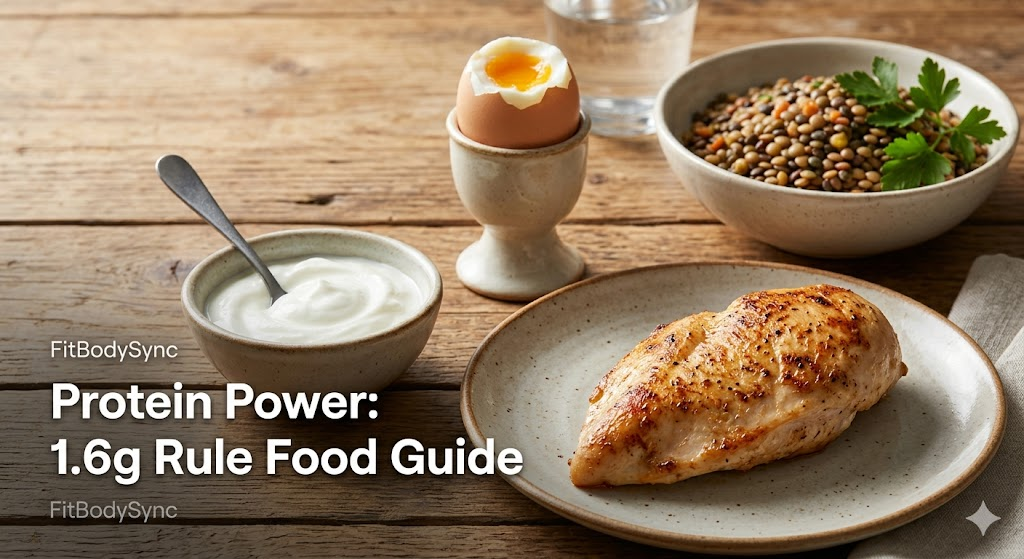
🍳 Food Sources of Protein
Protein can be obtained from a variety of foods, including:
- Eggs
- Dairy products
- Fish
- Poultry
- Lean meats
- Legumes
- Soy products
- Nuts and seeds
A balanced diet often includes protein from multiple sources.
🧍 What This Means in Daily Life
Most people do not need to calculate protein intake with perfect precision.
Practical habits may include:
- Including protein in meals
- Eating a balanced diet
- Meeting overall calorie needs
- Maintaining regular physical activity
Consistency is generally more important than achieving an exact daily number.
Breaking Down the 1.6g Rule
To keep things practical: the 1.6g rule means you try to get about 1.6 grams of protein for every kilogram you weigh.
If you’re used to pounds, just divide your weight by 2.2 first.
What this looks like in practice:
- For someone at 60kg: About 95-100g of protein.
- For someone at 75kg: About 120g of protein.
- For someone at 90kg: About 145g of protein.
A quick reminder: These aren’t strict laws. If you hit 1.4g one day because life got busy, you haven’t “failed.” Think of these as a general baseline. Research, including several well-regarded meta-analyses, suggests that for most active adults, the benefits of eating more protein start to taper off around this 1.6g mark. Eating double that won’t necessarily give you double the results.
Why This Actually Matters for Your Results
Think of your body as being under constant construction. Even when you’re just sitting at your desk, your tissues are breaking down and being replaced.
When you train, you’re essentially signaling to your body that it needs to rebuild those tissues a little bit stronger. But without enough protein, that signal doesn’t have the “bricks” it needs to follow through. This is often why two people can follow the same beginner weight loss plan and see totally different changes in their body composition.
- Person A hits their protein baseline and recovers well, feeling stronger each week.
- Person B ignores the protein side of things and often feels drained, wondering why their progress has stalled.
Beyond just muscle, protein is incredibly satiating. If you find yourself constantly hungry or crashing in the afternoon, it might just be that your meals are lacking the protein needed to stabilize your blood sugar and keep you full.
⚠️ Important Perspective
Protein requirements vary between individuals.
Factors influencing needs include:
- Age
- Activity level
- Body size
- Health status
- Training goals
There is no single protein intake target that applies universally to everyone.
Realistic Protein Sources
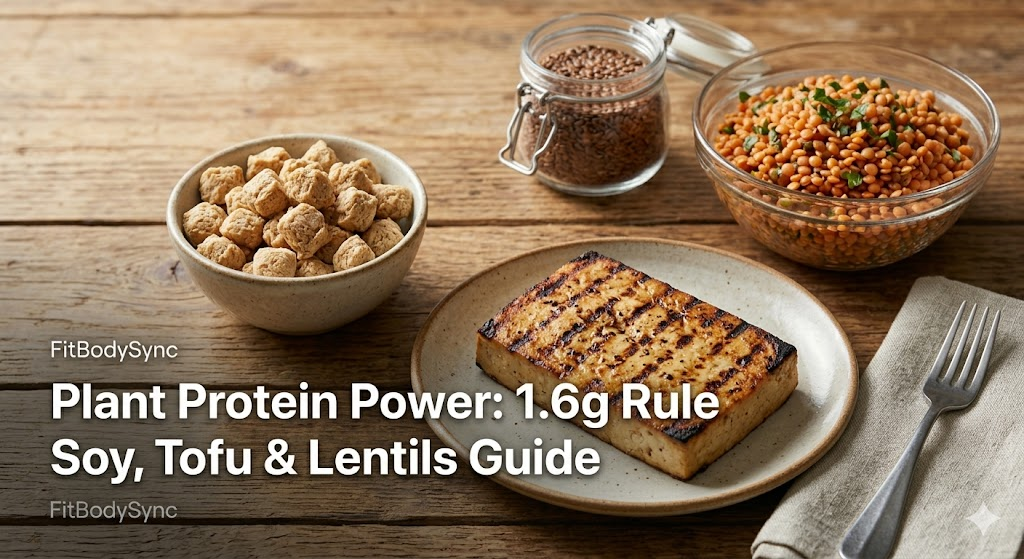
You don’t need expensive supplements or “fitness foods.” Most of your progress will come from standard items you can find at any grocery store.
| Source | Approx. Protein | Real-World Context |
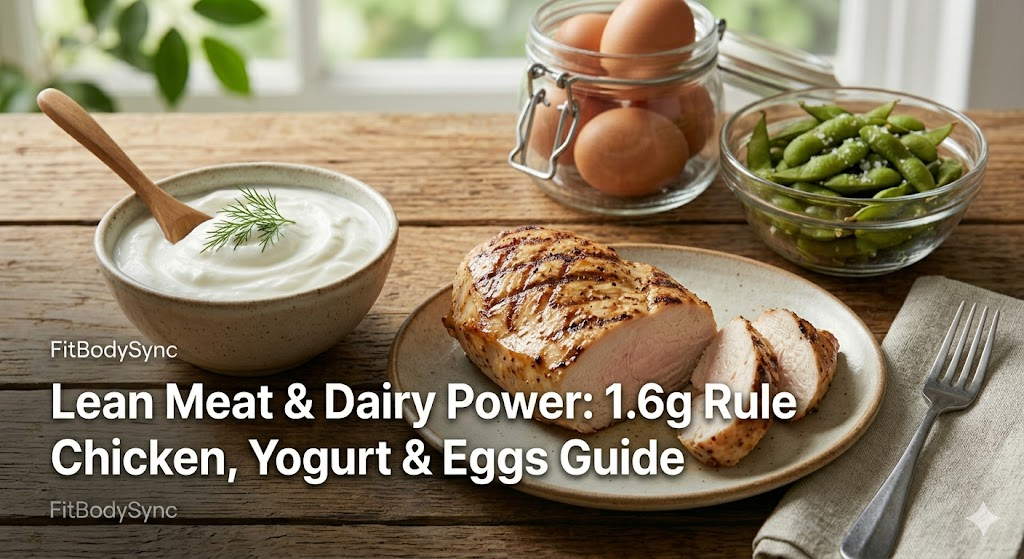
| Chicken/Turkey | 25-30g per 100g | A very common, effective choice for lean protein. |
| Whole Eggs | 6g per egg | Very easy to prep and highly bioavailable. |
| Greek Yogurt | 10g per 100g | Great for quick snacks or making sauces. |
| Tofu or Paneer | 15-20g per 100g | Vital for vegetarian diets; very filling. |
| Lentils/Beans | 8-9g per 100g | Adds fiber, though you need more volume. |
| Soy Chunks | 50g+ per 100g (dry) | A very effective plant-based protein source. |
The “Variety” Factor: Try not to get stuck eating the same thing every day. Mixing your sources—like having eggs for breakfast and lentils or chicken for dinner—ensures you’re getting a wider range of micronutrients, which is just as important for long-term health.
Does Timing Really Matter?
We’ve all seen people rushing to drink a shake the second they finish their last set. While it’s a common sight, the “anabolic window” isn’t nearly as small as people used to think.
Your total daily intake is the heavy hitter here. If you’re hitting your 1.6g/kg target over the course of 24 hours, your body has what it needs. That said, it’s usually easier on your digestion to spread that protein out across 3 or 4 meals rather than trying to eat 100g in one sitting.
If you can have a decent meal within a few hours of training, that’s great. If not? Don’t stress about it. How fat loss actually works depends much more on your habits over weeks and months, not minutes and hours.
Common Mistakes to Watch For
Even with the best intentions, it’s easy to get off track. Here are a few things I see often:
- Thinking “Healthy” Equals “High Protein”: A salad with avocado and nuts is healthy, but it might only have 5g of protein. Be mindful of what’s actually in your bowl.
- Relying Too Much on Shakes: Supplements are meant to supplement a diet, not replace it. Whole foods generally keep you fuller and provide more nutrients.
- The All-or-Nothing Mindset: If you miss your goal on a Saturday, don’t throw in the towel for the whole weekend. Just get back to your baseline on Sunday.
The Bottom Line
At the end of the day, protein should support your routine—not control it.
The 1.6g rule is just a tool to help you stop guessing and start seeing more consistent results from your time in the gym. It’s not about being perfect; it’s about being “good enough” consistently. Focus on whole foods, find a rhythm that works for your schedule, and let the results take care of themselves.
Suggested Reading:
⚠️ Disclaimer
This article is intended for educational purposes only and does not provide medical or nutritional advice. Individual nutritional requirements vary, and personalized guidance should be obtained from qualified healthcare professionals when appropriate.
📚 References
- National Institutes of Health (NIH)
- National Center for Biotechnology Information (NCBI)
- Harvard Health Publishing
- Academy of Nutrition and Dietetics
- International Society of Sports Nutrition (ISSN)
Next Step: Find Your Metabolic Bottleneck
Are you a Stalled Optimizer or a Metabolic Warrior? Stop guessing and start signaling.
To find out which of your 4 biological pillars is stalling your progress, take our 2-minute diagnostic:
Take the 2026 Bio-Recovery AuditDiscover your score across the 4 Pillars of Performance: Engine, Armor, Cleanup, and Repair.