

We live in the era of the “Quantified Self.” Whether you’re wearing an Oura Ring, a WHOOP, a Garmin, or an Apple Watch, you effectively have a high-tech medical laboratory strapped to your wrist. But for most people, these devices are just expensive step counters. They see a “Red” recovery score and feel a wave of anxiety, or they see a “90% Sleep Score” but still feel like they were hit by a truck.
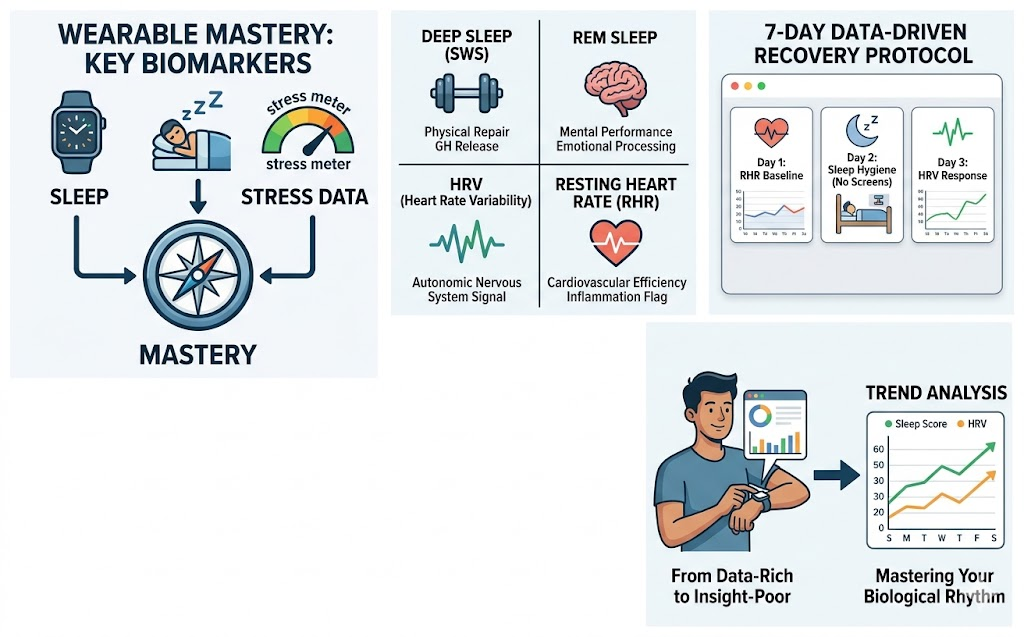
The truth is, your wearable doesn’t tell you how you feel—it tells you how your nervous system is responding. To achieve true Wearable Mastery, you have to move past the surface-level scores and look at the underlying biomarkers: HRV, RHR, and Sleep Architecture. In 2026, we don’t just track data; we use it to signal the body. Much like how Loaded Carries check your structural integrity, your wearable data checks your biological integrity.
[Image Placeholder: A close-up of a wearable showing a “Heart Rate Hammock” curve]
Disclaimer: Wearable data is for informational purposes and is not a substitute for medical diagnosis. If you have chronic heart or sleep issues, consult a medical professional.
THE PROBLEM: The Data-Intuition Disconnect
The “Modern Mismatch” isn’t just about sitting too much; it’s about being totally disconnected from our own internal signals. We’ve become so reliant on a watch to tell us if we’re tired that we’ve lost the ability to “feel” our own recovery.
This leads to Data Anxiety—where a bad “Readiness Score” actually ruins your day before it starts, triggering a cortisol spike that makes the data a self-fulfilling prophecy. According to the National Institutes of Health (NIH), misinterpreting wearable data can increase psychological stress.
🧠 Understanding Wearable Data
Modern fitness wearables collect information such as:
- Activity levels
- Heart rate
- Sleep duration
- Recovery estimates
- Stress-related metrics
These devices are designed to provide trends and insights rather than medical diagnoses.
Wearable measurements may vary between devices and should be interpreted as general indicators rather than exact health assessments.
😴 Sleep Metrics in Context
Many wearables estimate:
- Total sleep time
- Sleep stages
- Sleep consistency
- Recovery indicators
While these metrics can be helpful for identifying patterns, they may not perfectly reflect laboratory-based sleep measurements.
The most valuable use of sleep tracking is often observing long-term trends rather than focusing on a single night’s score.
THE WHAT: Defining the Master Bio-Markers
1. Heart Rate Variability (HRV): The Nervous System’s Compass
What it is: The variation in time between each heartbeat.
The Science: A steady, metronome-like heartbeat is actually a sign of a stressed, “brittle” nervous system. A high HRV means your nervous system is flexible—able to switch between “Fight or Flight” (Sympathetic) and “Rest and Digest” (Parasympathetic) effortlessly.
2. Resting Heart Rate (RHR): Your Baseline Engine Speed
What it is: The number of times your heart beats per minute while at complete rest.
The Science: Your RHR reflects your cardiovascular efficiency. If your RHR is 5-10 beats higher than your 30-day average, your body is fighting something—be it a virus, a hard workout, or systemic inflammation.
3. Sleep Architecture: Beyond “Time in Bed”
What it is: The breakdown of Light, Deep, and REM sleep cycles.
The Science:
- Deep Sleep (SWS): This is when your body releases growth hormone and repairs muscle tissue. It is heavily Magnesium-dependent.
- REM Sleep: This is the “Psychological Janitor” that processes emotions and clears out brain fog.
CASE STUDIES: Real-World Data Management
Case Study 1: The “Invisible” Overtrainer
Problem: David, 42, hit the gym 5 days a week. His device showed a “Green” recovery because his sleep was long (8 hours), but his HRV was trending downward. He felt irritable and his strength was plateauing.
Solution: We introduced two days of Vagus Nerve Stimulation and forced a “Deload” week.
Result: His HRV bounced back to baseline, and his strength levels hit a new PR within 14 days.
Case Study 2: The “Healthy” Night Owl
Problem: Sarah ate clean and exercised, but her Deep Sleep was consistently under 30 minutes. She felt “wired but tired” every morning.
Solution: We moved her last meal 4 hours before bed and implemented a “Digital Sunset” (no screens 60 mins before bed).
Result: Her Deep Sleep doubled in 7 days, and her daytime caffeine reliance dropped by 50%.
THE 7-DAY “DATA-TO-ACTION” PROTOCOL
Day 1: Establishing the “Zero Point” Baseline
- The Action: Analyze your data from the last 30 days. Find your personal average HRV and RHR.
- Common Mistake: Comparing your HRV to a friend or an online chart. HRV is highly genetic; your “low” might be someone else’s “high.” Compare only to your own history.
- The Goal: Stop the data anxiety by knowing what is “Normal” for you.
Day 2: The Caffeine Half-Life Experiment
- The Action: Hard “Caffeine Cutoff” at 10:00 AM. No stimulants after this time.
- The Data Point: Look at your Deep Sleep (SWS) duration tonight.
- Common Mistake: Thinking that because you “fall asleep fast” after an evening coffee, it isn’t affecting you. Caffeine blocks the receptors that allow you to reach stage 3 and 4 sleep.
- The Goal: See the direct link between caffeine and physical repair.
Day 3: The “HRV Cliff” (Alcohol & HRV)
- The Action: Have one glass of wine or beer with dinner—or, for the “Metabolic Warrior,” skip it entirely to see the contrast.
- The Data Point: Look at your Resting Heart Rate (RHR) and HRV tomorrow morning.
- Common Mistake: Believing “a nightcap” helps you sleep. While it helps you pass out, it spikes your heart rate all night.
- The Goal: Witness the biological cost of even a single drink.
Day 4: Thermal Stress & Sleep Latency
- The Action: Keep your bedroom at exactly 65°F (18°C) and take a hot shower 60 minutes before bed.
- The Data Point: Sleep Latency (time to fall asleep).
- Common Mistake: Sleeping in a warm room with heavy blankets. Your core temperature must drop to initiate deep sleep.
- The Goal: Use external temperature to trigger the internal “sleep switch.”
Day 5: The “Heart Rate Hammock” (Late-Meal Trap)
- The Action: Finish your last bite of food at least 4 hours before bed.
- The Data Point: The “Heart Rate Curve” in your app.
- Common Mistake: Eating a high-protein or high-carb meal right before bed. Digestion is an active process that keeps your heart rate elevated.
- The Goal: Achieving the “Hammock” shape (where HR drops early in the night) for maximum recovery.
Day 6: The Parasympathetic Override
- The Action: 10 minutes of “Box Breathing” (4-4-4-4) immediately before sleep.
- The Data Point: Nighttime “Stress Score” or “Body Battery.”
- Common Mistake: Scrolling on your phone while “trying to relax.” Blue light and social media spikes dopamine, which is the opposite of recovery.
- The Goal: Manually flipping your nervous system into “Rest and Digest” mode.
Day 7: The Weekly “Bio-Audit”
- The Action: Compare the data from the last 6 days. Which change had the biggest impact?
- Common Mistake: Trying to fix everything at once. Focus on the one habit that gave you the biggest HRV/Sleep boost.
- The Goal: Identifying your “High-Leverage Move” for long-term health.
THE WHY: Technical Outcomes and Biological Synergy
When you master your wearable data, you synchronize your lifestyle with your biology. By improving your sleep architecture, you maximize the hormonal benefits of your AMPK and mTOR signaling. High-quality REM sleep ensures you have the focus for Mental Performance, while Deep Sleep provides the physical repair for your next Workout Protocol.
📊 Stress Metrics and Recovery
Stress-related metrics often use physiological signals such as heart rate variability and heart rate patterns.
These measurements may provide useful information about recovery and daily readiness.
However, stress scores should be viewed as one piece of information among many factors including:
- Sleep quality
- Physical activity
- Lifestyle habits
- Personal well-being
🧍 What This Means in Daily Life
Wearable devices can help individuals become more aware of lifestyle habits.
Many people find it useful to track trends related to:
- Sleep consistency
- Exercise habits
- Daily movement
- Recovery patterns
Long-term habits generally have a greater impact on health than any individual wearable score.
THE 7-DAY “DATA-DRIVEN RECOVERY” PROTOCOL
| Day | Focus Metric | Action Step | Why it works (Lab Tech View) |
|---|---|---|---|
| Day 1 | RHR Baseline | Check RHR upon waking. | Identifies systemic fatigue early. |
| Day 2 | Sleep Hygiene | No screens 90 min before bed. | Increases natural melatonin production. |
| Day 3 | HRV Response | Track HRV after a hard workout. | Measures your “Internal Recovery” speed. |
| Day 4 | Stress Mapping | Tag “Stress Spikes” in your app. | Connects mental stress to physical markers. |
| Day 5 | Deep Sleep Push | Use magnesium + cooler room temp. | Optimizes SWS (Slow Wave Sleep) phase. |
| Day 6 | Trend Analysis | Look at the 7-day average. | Removes daily “noise” for real insights. |
| Day 7 | Digital Detox | Wear the device, but don’t check it. | Prevents “Data Anxiety” and resets the mind. |
TROUBLESHOOTING: When the Device is Wrong
As a medical professional, I must emphasize that wearables have limitations:
- Tattoos & Skin Tone: These can interfere with optical heart rate sensors (PPG).
- Wrist vs. Chest: For true HRV accuracy during exercise, a chest strap is superior to a wrist watch.
- The “Anxiety Loop”: If checking your data makes you anxious, stop. Mental health is more important than a sleep score. Follow the CDC’s physical activity guidelines regardless of what your watch says.
⚠️ Important Perspective
Wearable technology continues to improve, but consumer devices are not substitutes for professional medical evaluation.
Data should be used as a tool for awareness and self-monitoring rather than as a definitive assessment of health status.
FAQ: Performance Science Deep Dive
Why does my watch say I’m stressed when I’m just sitting at my desk?
Mental stress and physical stress look identical to your heart. If you’re under a deadline, your watch sees the same “Fight or Flight” signal as if you were running from a predator. Take 2 minutes for Vagus Nerve breathing.
Can I trust the “Sleep Stages” on my watch?
According to the Mayo Clinic, wrist-based wearables are about 70-80% accurate. Use them for trends, not as absolute medical truth.
Does Magnesium affect my data?
Many athletes see an immediate jump in HRV and Deep Sleep after starting a high-quality Magnesium protocol.
FINAL TAKEAWAY: The Biological Rhythm of Life
Wearable Mastery is the difference between being a slave to a gadget and being the master of your recovery. Use the data to spot the patterns that your brain tries to justify—the late-night snacking, the extra cup of coffee, the skipped rest day.
Once you stabilize your recovery, you can push your performance to the next level. If your data is consistently “Green,” it’s time to move to the Hybrid Training pillar and challenge your system with The King of Functional Moves.
⚠️ Disclaimer
This article is for educational purposes only. Wearable devices provide estimates and trend information and should not be used to diagnose, treat, or monitor medical conditions. Health concerns should be discussed with qualified healthcare professionals.
📚 References
American College of Sports Medicine (ACSM)
National Institutes of Health (NIH)
National Center for Biotechnology Information (NCBI)
Harvard Health Publishing
Cleveland Clinic
Next Step: Find Your Metabolic Bottleneck
Are you a Stalled Optimizer or a Metabolic Warrior? Stop guessing and start signaling.
To find out which of your 4 biological pillars is stalling your progress, take our 2-minute diagnostic:
Take the 2026 Bio-Recovery AuditDiscover your score across the 4 Pillars of Performance: Engine, Armor, Cleanup, and Repair.