

Introduction: The Post-Prandial Secret
We’ve all felt it: that heavy, foggy “food coma” that hits about 30 minutes after a big lunch. You reach for a second cup of coffee or a sugary snack to wake up, unwittingly starting a rollercoaster of blood sugar spikes and crashes that lasts all day.
In my years working in laboratory science and public health, I’ve seen thousands of glucose curves. The most frustrating part? Most people try to fix these spikes with complex diets or expensive supplements, when the most effective tool is literally right outside their front door—or even just down the hallway.
A simple 10-minute walk after eating is one of the most powerful ways to support your metabolic health. It isn’t a “secret trick”; it’s a fundamental biological lever. By the end of this guide, you’ll understand how to use this habit to stabilize your energy, protect your long-term health, and support your visceral fat loss journey.
THE PROBLEM: The “Silent” Glucose Spike
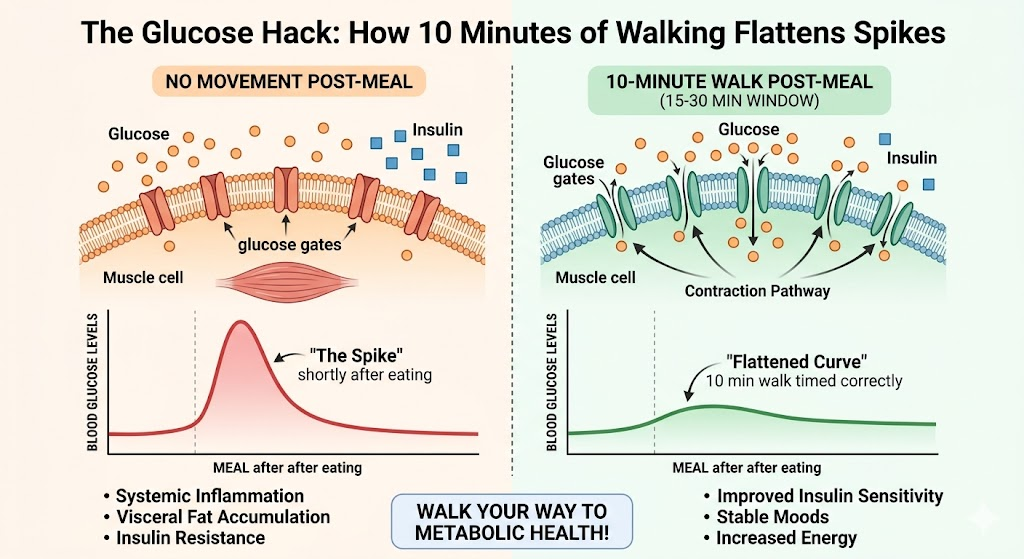
When we eat, our body breaks down carbohydrates into glucose (sugar), which enters the bloodstream. In a healthy metabolism, the pancreas releases insulin to “unlock” our cells so they can take in that sugar for energy.
The Modern Mismatch: In our modern world, we usually eat a meal and then immediately sit down—at a desk, in a car, or on the couch. Because our muscles aren’t moving, they don’t “demand” that sugar. The glucose sits in the bloodstream, forcing the pancreas to pump out higher and higher levels of insulin.
Over time, this leads to Insulin Resistance. Your cells stop “listening” to insulin, and your body begins storing that excess sugar as visceral fat. This is the root cause of the “Stalled Optimizer” profile—someone who eats well but can’t seem to lose the midsection.
THE WHAT: Understanding GLUT4 Translocation
So, why does a 10-minute walk work so well? It comes down to a process called Non-Insulin Mediated Glucose Uptake.
When your large muscle groups (like your quads and glutes) contract during a walk, they require immediate fuel. They can actually pull glucose directly out of the blood without needing a huge surge of insulin.
The Feeling: Because you avoid the massive spike, you also avoid the massive “crash” that causes brain fog and cravings. This is a key component of maintaining mental performance and focus.
The “Backup System”: Think of walking as a “secondary drain” for your blood sugar.
The Result: Instead of a sharp, jagged spike in blood sugar, you get a gentle, manageable curve.
THE SOLUTION: The “10-Minute Flattening” Protocol
The solution is all about timing. You don’t need to run a marathon; you just need to signal your muscles while the glucose is entering your bloodstream.
Step 1: The Window
The ideal window for your walk is 15 to 30 minutes after you finish eating. This is when the glucose from your meal is just starting to peak in your blood.
Step 2: The Intensity
This is not a “workout.” You should walk at a “Zone 1” pace—enough to move your legs and breathe through your nose, but not enough to break a sweat. If you are already using resistance bands, save those for your dedicated strength sessions. This walk is purely for metabolic clearing.
Step 3: The Duration
10 minutes is the clinical “sweet spot.” It is long enough to activate the GLUT4 transporters but short enough to fit into any busy schedule.
THE COMMON MISTAKES: Why “Walking Later” Isn’t the Same
Before we dive into the protocol, let’s look at why most people miss the benefits of this habit:
1. Waiting Too Long
If you wait two hours after a meal to walk, the glucose spike has already happened. The damage to your vascular system and the insulin surge have already taken place. The “Golden Window” is within 30 to 60 minutes of finishing your last bite.
2. Making it Too Intense
This is not a “workout.” If you go for a high-intensity run after eating, your body may actually release more glucose from the liver to fuel the effort, temporarily increasing your spike. A brisk, conversational pace is the “Sweet Spot.”
3. Consistency vs. Intensity
Walking for 70 minutes once a week is nowhere near as effective as walking for 10 minutes after every meal. We are looking for frequent metabolic signaling, not a weekend warrior effort.
THE HOW: The Metabolic Clearing Table
| Phase | Action | Focus | Clinical Objective |
| 0-15 Min Post-Meal | Rest/Digest | Parasympathetic activation | Allow initial digestion to begin. |
| 15-25 Min Post-Meal | 10-Min Walk | Large muscle recruitment | Trigger GLUT4 translocation. |
| 25+ Min Post-Meal | Return to work | Sustained clearing | Maintain low insulin requirement. |
CASE STUDIES: Real-World Metabolic Shifts
Case Study 1: The “Afternoon Slump” Executive
The Problem: James, 45, felt he needed a nap every day at 2:00 PM. He thought it was “just getting older.” His wearable data showed high “Stress Levels” during the afternoon, which was actually a physiological response to crashing blood sugar. The Solution: James committed to a 10-minute walk around his office building after lunch—no phone, just movement. The Result: His afternoon brain fog vanished. By stabilizing his lunch spike, he no longer craved sugar at 4:00 PM, leading to an effortless 2lb weight loss in the first month.
Case Study 2: The Evening Snacker
The Problem: Sarah found herself “grazing” on chips and sweets after dinner, despite eating a full meal. The Solution: We implemented a 15-minute family walk immediately after dinner. The Result: The walk lowered her post-dinner glucose spike. Because her blood sugar stayed stable, the “false hunger” signals in her brain disappeared, and she found it easy to stop eating for the night.
THE RESULTS: What You Can Expect
- Immediately: No “post-meal coma” or lethargy.
- Days 14–21: Improved insulin sensitivity and better recovery scores.
- Day 30+: Reduction in waist circumference (visceral fat) and more stable moods throughout the day.
THE 7-DAY GLUCOSE STABILITY PROTOCOL (Detailed)
This is a granular plan to turn walking into a metabolic weapon.
Day 1: The Baseline Observation
- The Action: Eat your normal meals, but pay close attention to how you feel 45 minutes afterward. Are you sleepy? Irritable?
- Common Mistake: Changing your diet on Day 1. Don’t. Just observe the “sedentary slump.”
- The Goal: Build the “Mind-Body Connection” so you understand why you need the walk.
Day 2: The “Lunch Break” Signal
- The Action: After your largest meal of the day, set a timer for 10 minutes and walk.
- The Pace: Brisk enough that your heart rate rises slightly, but slow enough that you could still hold a phone call.
- The Why: Lunch is usually when we are most sedentary (sitting at a desk). This walk “re-starts” the metabolic engine for the afternoon.
Day 3: The Dinner “Clean-Up”
- The Action: Add a 10-15 minute walk after dinner.
- The pace: Slower and more relaxing.
- The Why: Lowering your evening spike is critical for optimizing your sleep architecture. High glucose at night is a primary cause of waking up at 3:00 AM.
Day 4: The “Indoor Alternative” (No Excuses)
- The Action: If it’s raining or you’re stuck in a meeting, do 5 minutes of “Air Squats” or pacing inside your house.
- The Why: Your muscles don’t care if you’re outside; they only care that they are contracting.
- The Feel: You will notice that even 5 minutes of movement can “lift” the heavy feeling in your stomach.
Day 5: The Carbohydrate Test
- The Action: Eat a meal slightly higher in carbs (like pasta or a sandwich) and immediately follow it with a 15-minute walk.
- The Why: You are testing the “buffering” power of movement.
- Common Mistake: Thinking the walk “cancels out” a bad diet. It helps, but quality still matters for AMPK activation.
Day 6: The Morning Momentum
- The Action: Add a 5-minute walk after breakfast.
- The Why: This sets your “circadian rhythm” and helps sensitive your insulin receptors for the rest of the day.
Day 7: The Weekly Bio-Audit
- The Action: Review your energy levels. Did you have more focus this week? Did your “food comas” decrease?
- The Goal: Cementing this as a permanent habit.
TROUBLESHOOTING: Why It Might Not Work
- Waiting Too Long: If you wait 2 hours to walk, the insulin has already done its job (storing the sugar as fat).
- Too High Intensity: If you run, you might trigger a “stress response” (cortisol), which can actually cause the liver to release more sugar into the blood. Keep it easy.
- Meal Composition: If your meal is extremely high in processed sugar, a 10-minute walk may not be enough to counter the massive spike.
WHY IT WORKS: The Science of the “Muscle Sponge”
When you walk after a meal, you are engaging in Glucose Partitioning.
- Without Walking: Sugar is pushed into fat cells for storage.
- With Walking: Sugar is “pulled” into muscle cells for immediate use.
This is the foundation of becoming a Metabolic Warrior. By managing your glucose, you allow your body to spend more time in “Cleanup” mode (AMPK) rather than “Storage” mode. This works in perfect synergy with Magnesium supplementation, which is a co-factor for over 300 enzymatic reactions involving glucose metabolism.
Quick Reference: The Walking Guide
| Meal | Duration | Purpose |
| Breakfast | 5 Minutes | Sensitivity Reset |
| Lunch | 10 Minutes | Afternoon Focus / Productivity |
| Dinner | 15 Minutes | Evening Glucose Clearance / Sleep Quality |
WHEN IT WON’T WORK: The Honesty Clause
To be a trusted authority, we must be honest about the limits:
- The “Mega-Cheat” Meal: If you eat 2,000 calories of refined sugar and flour, a 10-minute walk is not a magic eraser. The spike will still be significant.
- Chronic Lack of Sleep: If you are only sleeping 4 hours, your cortisol will be so high that your body will remain insulin resistant regardless of your walking.
- Medical Conditions: If you are a Type 1 or Type 2 Diabetic, this habit is a tool, not a replacement for your medication. Always work with your doctor.
FAQ
Does a treadmill count?
Absolutely. Any form of steady movement that uses the legs will work. However, walking outside has the added benefit of “Optic Flow,” which helps lower neurological stress.
Can I just stand at a standing desk?
Standing is better than sitting, but it doesn’t provide the rhythmic muscle contractions needed to “pump” glucose out of the blood as effectively as walking.
What if I can’t walk after every meal?
Prioritize the walk after your largest meal or the meal with the most carbohydrates. Usually, for most people, this is lunch or dinner.
FINAL TAKEAWAY: Walk Your Way to Health
Metabolic health doesn’t have to be complicated. You don’t need a Continuous Glucose Monitor (CGM) to know that high spikes are draining your energy and stalling your fat loss.
By simply stepping outside for 10 minutes after you eat, you are taking control of your biology. You are moving from a Stalled Optimizer to a Metabolic Warrior.
Ready to see how your movement affects your internal recovery? Check out our guide on interpreting your wearable data to see your RHR and HRV improve as your glucose stabilizes.
Disclaimer: The information provided in this post is for educational and informational purposes only and is not intended as medical advice. If you have a metabolic disorder, heart condition, or are on glucose-lowering medication, consult with your healthcare provider before making changes to your post-meal routine. Use of these protocols is at your own risk.
Next Step: Find Your Metabolic Bottleneck
Are you a Stalled Optimizer or a Metabolic Warrior? Stop guessing and start signaling.
To find out which of your 4 biological pillars is stalling your progress, take our 2-minute diagnostic:
Take the 2026 Bio-Recovery AuditDiscover your score across the 4 Pillars of Performance: Engine, Armor, Cleanup, and Repair.