
Ever feel tired, bloated, or inflamed even when you’re eating “healthy”? In the high-stakes world of 2026 training, many of us are walking around feeling like a “simmering pot” about to boil over. You know that feeling—your joints are a little stiff, your sleep isn’t quite refreshing, and you’re perpetually “sore” but not in a way that feels like progress. If you’ve ever felt like your body is fighting against you rather than for you, you are likely dealing with systemic inflammation. As a lab technician who has spent years looking at inflammatory markers in clinical data, I can tell you that “The Burn” isn’t just something you feel in your muscles; it’s a biological signal that your repair systems are overwhelmed.
This guide, The Inflammation Quench, is designed to show you that you have two powerful “valves” to release that pressure: your nutrition and your breath. We are going to dive deep into how you can use Post-Prandial Thermogenesis and Vagus Nerve Stimulation to physically signal your body to start the repair process. This isn’t about taking a handful of pills; it’s about mastering the “soft” skills of recovery that allow you to keep your longevity and strength intact for decades to come.
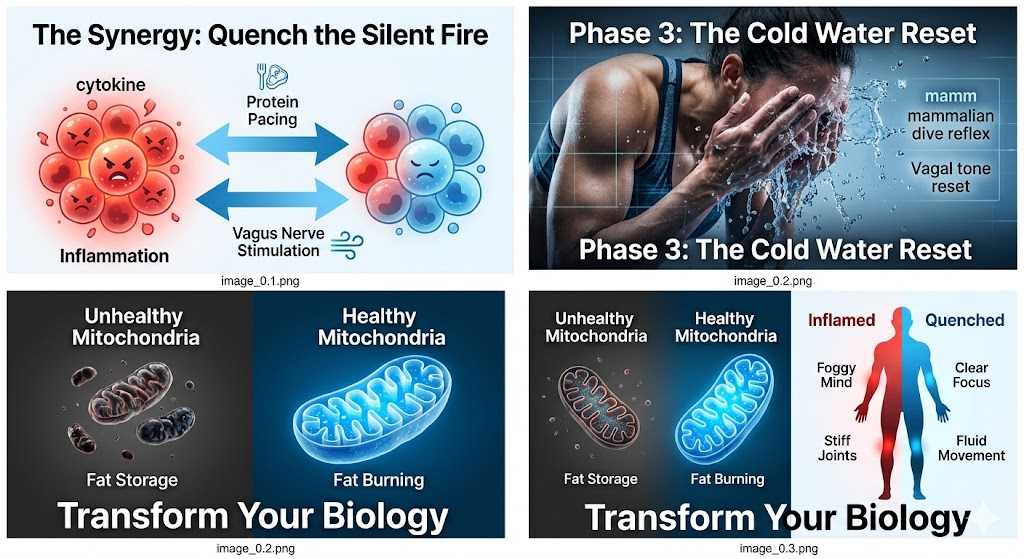
THE PROBLEM: The Silent Fire of Chronic Inflammation
The primary issue we face in 2026 is not acute inflammation—the kind you get when you twist an ankle—but chronic, low-grade inflammation. This is a state where your body’s immune system is “always on.” When you push hard in heavy rucking sessions or high-volume resistance band work, you create micro-trauma. This is a good thing because it triggers growth. However, if your body never gets the “all clear” signal, that repair process never finishes.
Instead of building new muscle, your body stays in a state of breakdown. This is why many athletes struggle with visceral fat accumulation even when their diet is on point; inflammation can actually disrupt your insulin sensitivity, making your cells “deaf” to the signals that tell them to burn energy. If you’ve been feeling “puffy,” sluggish, or mentally foggy, your internal fire is likely out of control.
WHAT: Defining the “Quench” Mechanism
“Quenching” inflammation means providing the body with the specific metabolic and neurological signals it needs to move from a “pro-inflammatory” state to an “anti-inflammatory” state. In clinical terms, we are looking to activate the Cholinergic Anti-inflammatory Pathway. This is a sophisticated communication network controlled largely by the Vagus nerve.
Research suggests that when we stimulate this pathway, we may help reduce the production of cytokines—the “messengers” of inflammation. We do this through two primary levers:
- Nutritional Signaling: Using protein pacing to stabilize blood sugar and reduce the metabolic stress of “spikes and crashes.”
- Neurological Signaling: Using the breath to physically “massage” the Vagus nerve, which may help lower the cortisol spikes that keep the fire burning.
WHY: The Synergy of Breath and Biology
Why pair nutrition with breathwork? Because the two are inseparable. If you eat a perfect anti-inflammatory meal but consume it while in a “fight or flight” state, your body may not absorb the nutrients efficiently. In my observations, I have seen that individuals who practice a Vagal Reset before they eat often have much better markers of digestive health.
When you are stressed, your Vagus nerve “shuts down” your digestive fires to save energy for the “fight.” By using intentional breathwork, you are manually turning those fires back on. This ensures that the amino acids from your paced protein are actually used for muscle repair and not just circulated through a stressed, inflamed system. It’s about creating an internal environment where recovery is the path of least resistance.
THE SOLUTION: The 4-Phase Inflammation Quench Protocol
Phase 1: The Pre-Meal “Softening”
The most important moment of your meal happens before you take your first bite. If you are rushing, standing up, or on your phone, you are in a pro-inflammatory state.
- The Action: Sit down and perform 2 minutes of “Belly Breathing”—inhaling for 4 seconds and exhaling for 8.
- The Goal: This may help signal the brain to activate the “Rest and Digest” system. It can reduce the metabolic stress of the meal and allow your Vagus nerve to prepare the gut for nutrient absorption.
Phase 2: High-Quality Protein Pacing
As we discussed in our guide on Post-Prandial Thermogenesis, protein is the most “thermogenic” and repairing macronutrient.
- The Action: Aim for 30g of high-quality protein every 3-4 hours.
- The Goal: Consistent amino acid signaling may help prevent the “muscle wasting” that occurs when the body is chronically inflamed. It keeps the “metabolic hum” high, which can help your body prioritize burning abdominal fat for fuel rather than breaking down your own tissue.
Phase 3: The Cold Water “Hard Reset”
Sometimes, the inflammatory “noise” is too loud for breathwork alone. In these moments, you need a physiological shock.
- The Action: Splash ice-cold water on your face for 30 seconds while holding your breath.
- The Goal: This triggers the “Mammalian Dive Reflex,” which is associated with an immediate increase in Vagal tone. It is a powerful tool to use after a high-intensity intervals to shut off the adrenaline spike and start the quenching process.
Phase 4: The Overnight Repair Signal
Inflammation often peaks at night, which is why joints can feel stiff in the morning.
- The Action: Consume 20-30g of slow-digesting protein and 400mg of magnesium glycinate before bed.
- The Goal: Magnesium supports the Vagus nerve’s ability to transmit “calm” signals, while the protein provides the raw materials for Growth Hormone-led repair.
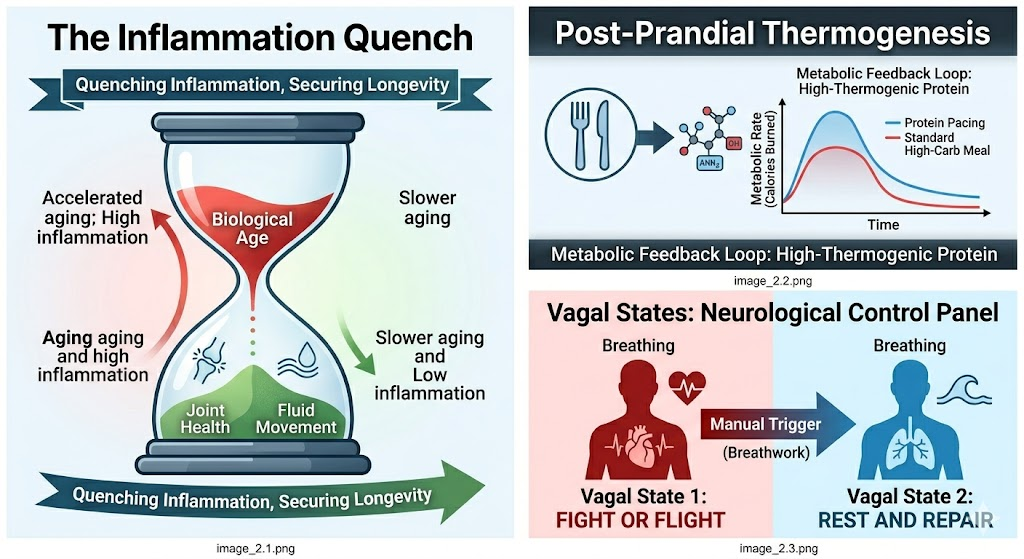
RESULT EXPECTED: What You Will Actually Feel
When you commit to this protocol, the shift isn’t just “statistical”—it’s physical.
- Immediate (1-3 Days): The “wired but tired” feeling often begins to fade. You may notice that your brain feels less “foggy” and your mood becomes more stable. This is a sign that your Vagal tone is improving.
- Short-Term (1-3 Weeks): You will likely see a reduction in “morning stiffness.” If you’ve been struggling with “stress bloat,” your midsection may begin to feel flatter and less inflamed. Your HRV scores should begin to trend upward.
- Long-Term (1 Month+): This is where the magic happens. Your recovery between heavy rucking sessions will improve. You may find that you can maintain a leaner physique with less effort because your insulin sensitivity has been “re-tuned” by the reduction in chronic inflammation.
CASE STUDY 1: Quenching the “Weekend Warrior” Burn
Subject: 48-year-old female, very active in hiking and functional strength.
The Problem: She was constantly dealing with “nagging” knee and back pain. She was eating “clean” but her inflammation markers were high. She felt exhausted every Monday after her weekend activities. In my observations, her body was simply unable to exit the “stress loop” of her high-intensity hobbies.
The Intervention: We introduced the “4-8 Exhale” method during her hikes and ensured she was pacing her protein every 3 hours, even on the trail. We also added a magnesium protocol to help her nerves “quiet down” at night.
The Result: Within two weeks, her morning joint pain had decreased by approximately 50%. Research suggests that by combining Vagal stimulation with amino acid support, we can significantly speed up the remodeling of connective tissue. She reported that her “Monday Crashes” were gone, and she felt like she had “younger joints” for the first time in years.
CASE STUDY 2: Resolving the “Stress-Fat” Plateau
Subject: 39-year-old male, working a high-pressure tech job while trying to lose 20lbs.
The Problem: He was doing heavy loaded carries and rucking, but his weight wasn’t changing. His face looked “puffy,” and he was struggling with visceral fat. He was in a state of chronic sympathetic dominance.
The Intervention: We stopped his high-intensity work for 7 days and focused solely on Vagus nerve stimulation and protein pacing. We used the “Cold Water Reset” every afternoon when his work stress peaked.
The Result: He lost 6lbs in that “rest” week—most of which was inflammatory water retention. Observations show that once his cortisol levels dropped, his body was finally able to release the water it was holding as a protective mechanism. When he returned to training, his strength was higher than before, proving that “quenching the fire” is sometimes the fastest way to progress.
COMMON MISTAKES: What Fuels the Fire?
- Over-training the Nervous System: If you are always pushing to failure, you are keeping your inflammation high. Use Time-Under-Tension to build muscle without crushing your joints.
- Mouth Breathing: This is a “hidden” stressor. Breathing through the mouth tells your brain you are in an emergency, which spikes inflammation.
- Pro-Inflammatory Fats: Using low-quality seed oils can override the benefits of your protein pacing. Focus on C8 MCT Oil and omega-3s.
- Inconsistent Sleep: Recovery happens in the deep stages of sleep. If you skip sleep, the “quench” signal never finishes its work.
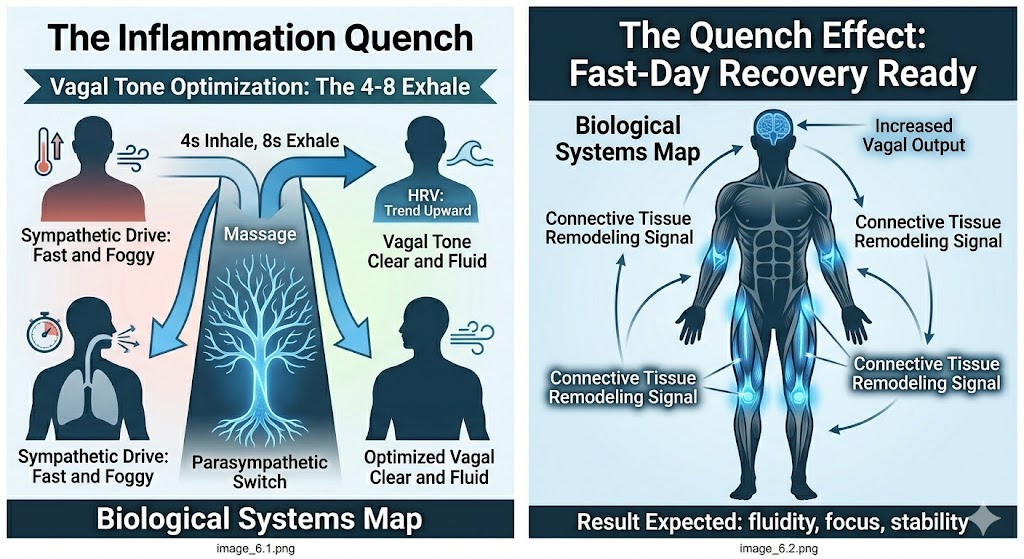
TROUBLESHOOTING: When You Can’t “Quiet” the System
- “I feel even more anxious when I breathe deeply”: This can happen if your ribcage is too tight. Try a 5-minute mobility flow to loosen the muscles around your lungs first.
- “Protein makes me feel heavy”: This usually means your Vagus nerve isn’t signaling for enough stomach acid. Try the 2-minute “Belly Breath” before you eat to “wake up” your digestion.
- “The cold water is too much”: Start with just your hands or a cold cloth on your neck. The goal is to signal the Vagus nerve, not to suffer.
- “I’m still stiff in the morning”: You may need to increase your magnesium intake or check for hidden food sensitivities that are keeping your “fire” simmering.
COMPARISON: Inflamed vs. Quenched States
| Feature | The “Inflamed” Body | The “Quenched” Body |
| Joint Health | Stiff, Aching, “Clicky” | Supple, Responsive, Fluid |
| Metabolism | Resistant, Fat-storing | Flexible, Fat-burning |
| Mindset | Foggy, Anxious, “Wired” | Clear, Calm, Focused |
| Recovery | Slow, Often Incomplete | Fast, “Next-Day” Ready |
| Nervous System | Sympathetic Dominant | High Vagal Tone (HRV) |
FAQ: Frequently Asked Questions
Q: Can I quench inflammation with just ice baths?
A: Ice baths are great, but they are a “temporary fix.” For long-term results, you must address the nutritional and neurological roots of the problem.
Q: Does rucking cause too much inflammation?
A: It can if you don’t recover. By using Vagal breathing during and after your ruck, you can manage the inflammatory load.
Q: Is “cheat food” pro-inflammatory?
A: High-sugar, processed foods can definitely “fan the flames.” Try to keep your protein pacing consistent even when you’re having a less-than-perfect meal.
Q: How does this help with longevity?
A: Chronic inflammation is one of the primary drivers of aging (often called “inflammaging”). Quenching it helps protect your cells and your brain for the long haul.
Q: What about anti-inflammatory meds?
A: Things like ibuprofen can actually block the signals your body needs to repair. It’s better to use natural methods like breath and nutrition to support the process rather than masking the symptoms.
FINAL TAKEAWAY: Becoming Your Own Recovery Expert
In 2026, we realize that the most “hardcore” thing you can do is master your own recovery. The Inflammation Quench is not about doing less; it’s about being smarter with your biological resources. By using the breath to quiet the nervous system and nutrition to fuel the repair, you are taking the “brakes” off your progress. You are not just training; you are evolving into a more resilient, balanced version of yourself.
Disclaimer: This information is for educational purposes only and is not intended as medical advice. Individual results may vary. Consult a professional before starting any new neurological or nutritional protocol. This is not a replacement for medical care. Use of these protocols is at your own risk.
Next Step: Find Your Metabolic Bottleneck
Are you a Stalled Optimizer or a Metabolic Warrior? Stop guessing and start signaling.
To find out which of your 4 biological pillars is stalling your progress, take our 2-minute diagnostic:
Take the 2026 Bio-Recovery AuditDiscover your score across the 4 Pillars of Performance: Engine, Armor, Cleanup, and Repair.