

We’ve all seen them: the glossy “7-Day Total Body Transformation” or “Rapid Fat Loss” challenges that promise a completely new physique by next Sunday. They are incredibly seductive because they offer a clear, short-term finish line. But if you’ve ever tried one and ended up feeling more exhausted, bloated, and frustrated than when you started, you aren’t alone. In my work as a lab technician, I’ve looked at the metabolic data of “crash” programs, and the reality is often quite different from the marketing.
Most 7-day plans fail because they are designed for the “perfect” day, not for the “real” human. They treat your body like a machine that can be forced into submission rather than a biological system that responds to stress, signaling, and neuro-fitness. This guide is about pulling back the curtain on why these plans usually collapse and showing you the “Sustained Signal” approach that actually leads to longevity and strength.
Key Points: Why the 7-Day Model is Often Flawed
- Cortisol Overload: Attempting to go from zero to daily high-intensity training can cause a massive stress spike, which may actually encourage fat storage.
- The “Safety Brake”: Your vagus nerve is designed to protect you; if you move too fast, it will signal the body to slow down your metabolic rate.
- Inflammation vs. Growth: Rapid programs often create more systemic inflammation than your body can “quench,” leading to burnout rather than muscle repair.
- Gut-Brain Disconnect: Many short-term plans neglect the gut-health foundation needed to sustain energy and stabilize hunger.
THE PROBLEM: The “Burn and Crash” Metabolic Cycle
The primary reason most 7-day plans don’t work is that they ignore the “Recovery Lag.” When you train at high intensity seven days in a row, you are essentially constantly adding “fuel” to a fire without ever letting it burn out into a steady glow. This results in what we call “Sympathetic Dominance,” a state where your body is perpetually in “fight or flight.”
In this state, your insulin sensitivity may drop, and your body becomes resistant to burning visceral fat. You might see the scale move down by a few pounds, but it is often just water and muscle glycogen—not actual fat. Once the 7 days are over, the “rebound” effect kicks in, your cortisol remains high, and you likely regain whatever you lost, plus a little extra as a “protective” measure by your body. It’s a “hollow” victory that leaves your metabolism worse off.
WHAT: Defining the “Sustained Signal” Approach
In 2026, we’ve moved beyond the “sprint” mentality. We now focus on The Sustained Signal. This is the understanding that your body doesn’t respond to volume as much as it responds to consistency and rhythm.
Instead of trying to “kill it” for 7 days, we aim to provide the body with a consistent, low-stress signal that says “It is safe to burn fat and build muscle.” This involves balancing protein pacing with strategic recovery and functional movement. It’s the difference between a lightning strike and a solar panel—one is flashy but fleeting, while the other provides consistent, usable energy for years.
WHY: The Biology of Adaptation vs. Shock
Why does your body reject the 7-day plan? Because real biological change (adaptation) takes time. Your muscle fibers, mitochondria, and gut microbiome require a cycle of “Stress + Rest” to improve.
If you skip the “Rest” part, you aren’t adapting; you are just surviving. Research suggests that Growth Hormone—the hormone responsible for repair and fat burning—is primarily released during deep sleep and periods of high vagal tone. By crushing yourself for 7 days straight, you are actually suppressing the very hormones you need to see results. You are essentially screaming at your body to change, but it’s too exhausted to listen.
THE SOLUTION: What Actually Helps (The 4-Pillar Rhythm)
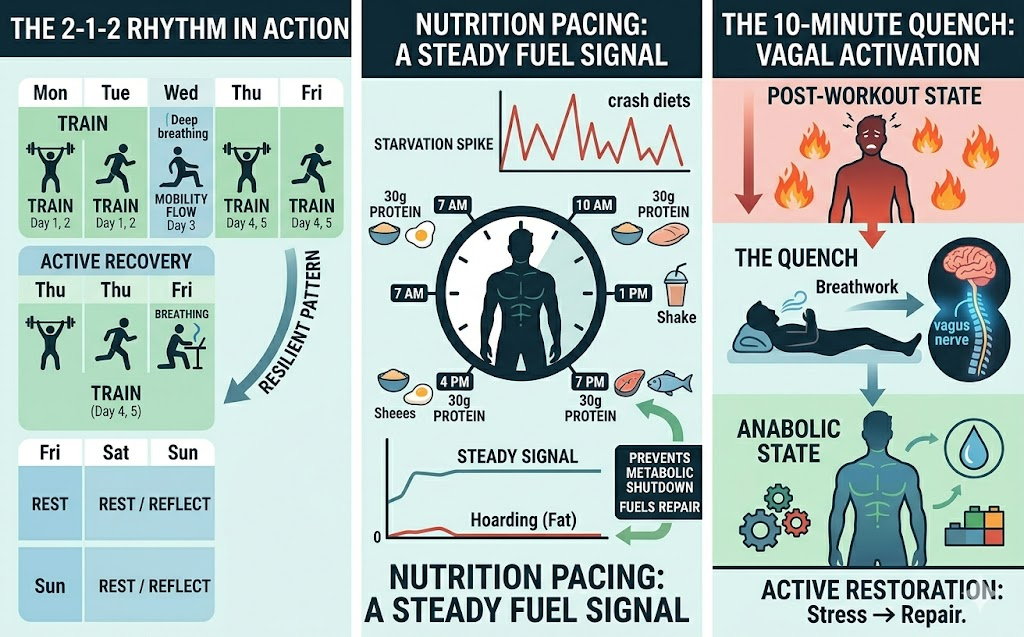
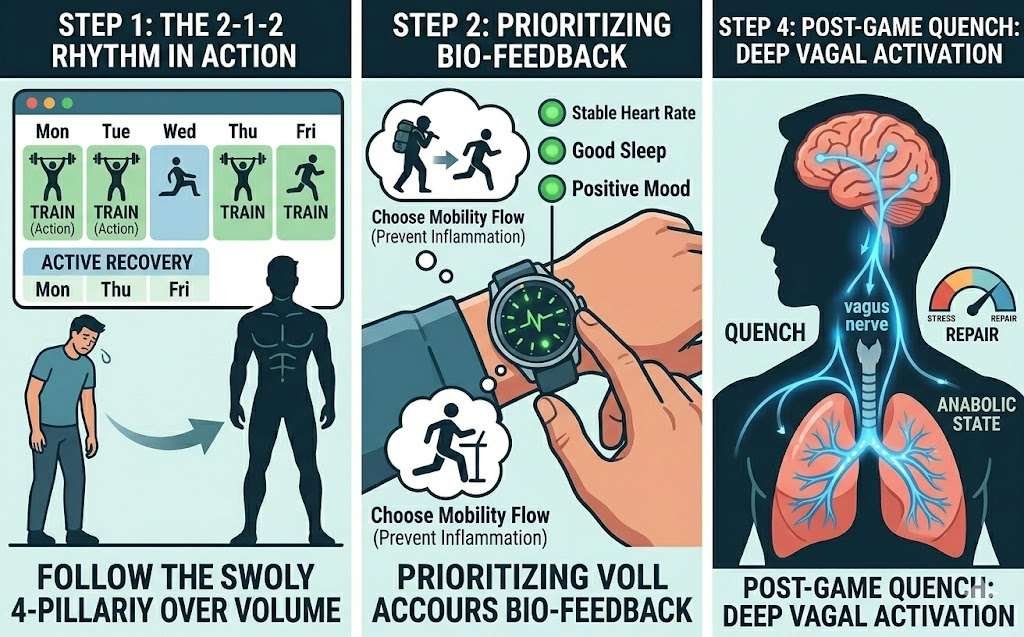
Step 1: The “2-1-2” Training Split
Instead of 7 days on, use a rhythm that respects your nervous system.
- The Action: Train for 2 days, take 1 day for active recovery/breathwork, and then train for 2 more.
- The Goal: This provides enough stress to trigger post-prandial thermogenesis without overwhelming your injury prevention threshold.
Step 2: Prioritize “Bio-Feedback” Over the Calendar
The calendar doesn’t know how you slept or how much stress you had at work.
- The Action: Check your “Morning Markers”—resting heart rate and mood. If you feel “wired but tired,” skip the heavy ruck and do a mobility flow.
- The Goal: This keeps your cortisol in check and prevents the systemic inflammation that halts fat loss.
Step 3: Nutrition “Pacing” (Not Starving)
7-day plans usually involve drastic calorie cuts. This is metabolic suicide.
- The Action: Maintain a consistent protein pacing protocol (30g every 3-4 hours) even on rest days.
- The Goal: This provides a “safety signal” to the body, ensuring it doesn’t enter “starvation mode” and start hoarding abdominal fat.
Step 4: The 10-Minute “Post-Game” Quench
Most people finish a workout and jump straight into their high-stress life.
- The Action: Spend 10 minutes performing Vagus Nerve Stimulation breathwork immediately after your session.
- The Goal: This “flips the switch” to repair mode, ensuring your hard work actually results in muscle fiber growth rather than just more stress.
RESULT EXPECTED: The Reality of a Sustained Approach
- Immediate (Week 1): Unlike a 7-day crash, you won’t feel “dead” by Friday. Your energy will be stable, and your gut health will feel more resilient. You might lose 1-2 lbs, but it will be sustainable progress.
- Short-Term (Month 1): This is where you surpass the “7-dayers.” Because you haven’t been injured, you’ve completed 20+ solid sessions. Your clothes will fit differently because you’ve actually changed your body composition.
- Long-Term (6 Months+): You have built a “Metabolic Fortress.” Your insulin sensitivity is optimized, and you are living with the functional independence that only comes from a rhythm that respects your biology.
CASE STUDY 1: The “Challenge” Junkie’s Recovery
Subject: 42-year-old female who did three back-to-back “7-day challenges.”
The Problem: She was “skinnier” but had more visceral fat proportionally (skinny-fat) and was constantly dealing with “brain fog.” Her Vagus nerve signaling was flat. In my observations, her metabolism had “down-shifted” to survive the constant stress.
The Intervention: We moved her to a “3-day-a-week” Time-Under-Tension routine with protein pacing. We prioritized fibermaxxing to heal her gut.
The Result: She actually increased her calories and lost 8lbs of fat over 6 weeks. Research suggests that by providing “Rest periods,” she allowed her thyroid and cortisol to normalize, which “unlocked” her fat-burning capacity. She reported feeling “powerful” rather than just “tired.”
CASE STUDY 2: The “Over-Rucker”
Subject: 48-year-old male who tried to ruck 5 miles every day for a week.
The Problem: By day 4, his knees were “clicking,” and his sleep was non-existent. He was Mistake 5 from our injury guide personified. He thought he was “weak.”
The Intervention: We scaled him back to 2 heavy rucks a week and 3 days of mobility flow. We also introduced the Magnesium “Reset” at night.
The Result: His knee pain vanished, and his rucking speed actually increased. Observations show that his muscles needed the anabolic window of rest to actually repair the tissue he was breaking down. He proved that “Less is often More” when it comes to longevity.
COMMON MISTAKES: Why We Fall for the 7-Day Trap
- The “Penance” Mindset: Many use 7-day plans to “punish” themselves for a bad weekend of eating. This creates a toxic relationship with exercise.
- Neglecting the “Floor”: We focus on the “Ceiling” (how hard can I go?) instead of the “Floor” (what is the minimum I can do to stay healthy?).
- Ignoring Sleep: If a plan tells you to wake up at 4 AM but you go to bed at 11 PM, it is an injury-waiting-to-happen.
- No “Quench” Strategy: 7-day plans rarely include anti-inflammatory breathwork, leaving you in a permanent state of “The Burn.”
TROUBLESHOOTING: Creating Your Own Plan
- “I feel guilty when I don’t work out”: This is a sign of sympathetic dominance. Remind yourself that Rest IS a Workout for your nervous system.
- “I’m not seeing results fast enough”: Remember, we are building for longevity. Real fat loss is 0.5 to 2 lbs a week. Anything more is likely muscle or water.
- “I like the intensity”: Great! Keep the intensity but lower the frequency. Try loaded carries for 20 minutes instead of an hour of mindless cardio.
- “What about my diet?”: Focus on fibermaxxing and protein. If those are solid, your 7-day plan won’t need to be so “extreme.”
COMPARISON: Crash Plans vs. The Sustained Signal
| Feature | 7-Day Crash Plan | The Sustained Signal |
| Primary Driver | Willpower / Panic | Biology / Rhythm |
| Metabolic State | High Cortisol (Catabolic) | High Growth Hormone (Anabolic) |
| Fat Loss | Mostly Water / Glycogen | Visceral Fat Oxidation |
| Sustainability | Very Low (Burnout) | High (Life-long Resilience) |
| Inflammation | Chronic / Escalating | Quenched / Productive |
FAQ: Frequently Asked Questions
Q: Is it EVER okay to work out 7 days a week?
A: Yes, if the “workout” is a low-intensity Vagal Walk or a light mobility flow. But 7 days of intensity is a recipe for disaster for most.
Q: Why do I feel so “bloated” on a crash plan?
A: That’s inflammatory water retention. Your body is “holding onto its shield” because it thinks it’s under attack.
Q: Can I do this while fasting?
A: Yes, but be careful. Fasting is a stressor. If you combine it with 7 days of hard training, your vagus nerve will likely rebel.
Q: How do I know if my plan is “working”?
A: Look for better sleep, more stable hunger, and better mood. These are the “Lead Indicators” of fat loss.
Q: Should I use resistance bands or weights?
A: Both work! What matters is the Proper Form and the Time-Under-Tension.
FINAL TAKEAWAY: Choosing the Path of Resilience
In 2026, we’ve learned that the fastest way to get to your goals is to stop trying to “hack” the timeline. Most 7-day plans don’t work because they treat your body like an enemy to be defeated. When you choose the “Sustained Signal” approach, you are treating your body like an ally. By respecting your nervous system and your metabolic rhythm, you aren’t just losing fat—you are building a body that is strong, independent, and unshakeable.
Disclaimer: This information is for educational purposes only and is not intended as medical advice. Individual results may vary. Consult a professional before starting any new exercise or nutritional protocol, especially if you have underlying conditions. This is not a replacement for medical care. Use of these protocols is at your own risk.
Next Step: Find Your Metabolic Bottleneck
Are you a Stalled Optimizer or a Metabolic Warrior? Stop guessing and start signaling.
To find out which of your 4 biological pillars is stalling your progress, take our 2-minute diagnostic:
Take the 2026 Bio-Recovery AuditDiscover your score across the 4 Pillars of Performance: Engine, Armor, Cleanup, and Repair.