

Introduction: The Portable Laboratory of Strength
In the world of fitness, there is a common myth that you need a room full of iron to build real strength. However, as a Certified Lab Technician with years of experience in the National Rural Health Mission (NRHM), I’ve seen that the body doesn’t recognize the source of resistance—it only recognizes tension.
Resistance bands are often viewed as “rehab tools,” but in 2026, they are being recognized as a clinical-grade solution for building durability without the joint impact of heavy weights. Whether you are a “Metabolic Warrior” traveling for work or someone training in a small apartment, resistance bands offer a way to maintain muscle mass and bone density with zero footprint. Most people don’t realize that the variable resistance of a band actually mimics human muscle fiber recruitment more naturally than a dumbbell.
🧠 Why Resistance Bands Are Popular
Resistance bands are lightweight, portable, and require very little storage space.
They are commonly used for:
- Home workouts
- Travel fitness
- Strength training
- Mobility exercises
- General physical activity
Because bands create resistance throughout a movement, they can be incorporated into many different exercise routines. Research and fitness experts note that resistance bands can be an effective training tool when used consistently.
🏋️ Building Strength With Limited Space
Many people do not have access to a large home gym or extensive equipment.
Resistance bands offer a practical option for individuals who want to exercise in:
- Apartments
- Small rooms
- Dormitories
- Travel settings
Effective strength training does not always require large machines or heavy equipment. Consistency and progressive challenge are often more important than the amount of equipment available.
THE PROBLEM: Strength Decay in a Sedentary World
The primary problem for the modern high-performer is Strength Decay. When we stop challenging our muscles against resistance, we don’t just lose “tone”—we lose the metabolic machinery that manages our blood sugar.
In my clinical work, I often see patients who have high visceral fat levels simply because they lack the muscle “sink” to absorb glucose. Intense gym sessions are great, but for most busy people, they are inconsistent. This inconsistency leads to a loss of the “Armor” that protects our joints. Research from the Mayo Clinic suggests that muscle mass is one of the strongest predictors of longevity, yet most people struggle to find the space or time for traditional lifting.
THE WHAT: Understanding Variable Resistance and Muscle Fiber Recruitment
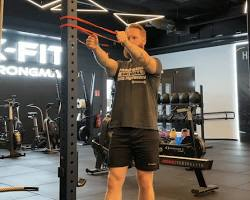
To understand why bands are effective, we have to look at the “What.” Unlike a 20lb dumbbell, which is 20lbs at the bottom and 20lbs at the top, a resistance band features Variable Linear Resistance.
- The Strength Curve: A band gets harder as it stretches. This matches your body’s “Strength Curve”—you are naturally stronger at the end of a movement (like the top of a chest press) than at the beginning.
- Increased Time Under Tension (TUT): Because you have to fight the band to keep it from snapping back, your muscles stay “on” during the entire rep.
As a Lab Tech, I explain to my clients that this constant tension is a signal for the body to produce growth hormone and improve insulin sensitivity. This is why bands are a secret weapon for maintaining metabolic flexibility.
🧍 What This Means in Daily Life
For many people, lack of space can become a barrier to exercise.
Portable equipment such as resistance bands may help support regular physical activity because they are easy to store and transport.
The most effective fitness routine is often one that can be maintained consistently over time.
THE SOLUTION: The 2026 “Minimalist Strength” Protocol
The solution is not just “stretching” the bands. To build muscle, you must use high-quality, clinical-grade tension.
Step 1: The “Engine” (Lower Body)
Large muscle groups drive the most metabolic change.
- The Move: Banded Goblet Squat.
- Why: This builds leg strength while forcing the core to stabilize against the band’s pull.
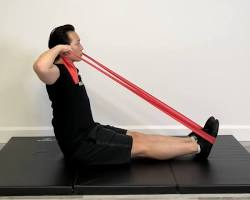
Step 2: The “Armor” (Upper Body Pull)
Our modern lifestyle pulls us forward into a “slouch.” We need to pull back.
- The Move: Banded Face Pulls or Seated Rows.
- Why: This strengthens the rear deltoids and thoracic spine, which is essential for bulletproof joints.
Step 3: The “Cleanup” (Core Stability)
Bands allow for “anti-rotation” work, which iron cannot easily do.
- The Move: Pallof Press.
- Why: This teaches your core to resist outside forces, protecting your spine.
⚠️ Important Perspective
No single training method is ideal for everyone.
Exercise selection should be based on:
- Individual goals
- Experience level
- Available equipment
- Physical limitations
- Personal preferences
Resistance bands are one option among many approaches to strength training.
THE HOW: The 2026 Space-Saving Strength Table
| Exercise | Sets/Reps | Focus | Clinical Objective |
| Banded Squat | 3 Sets x 15 Reps | Quad/Glute Power | Glucose disposal and metabolic rate increase. |
| Overhead Press | 3 Sets x 12 Reps | Shoulder Stability | Improve vertical “Armor” and overhead reach. |
| Single Arm Row | 3 Sets x 10 Reps | Back/Posture | Counteract “Office Chair Syndrome.” |
| Banded Push-up | 2 Sets x Max | Chest/Triceps | Increase peak force at the top of the move. |
| Pallof Press | 2 Sets x 30 Sec | Core Anti-Rotation | Spinal decompression and stability. |
CASE STUDY 1: Reversing Muscle Loss in a Traveling Professional
A 35-year-old consultant I worked with was losing 2-3 lbs of muscle every year due to frequent travel and a lack of hotel gym access. We replaced his missing workouts with a 20-minute resistance band protocol. Despite no “heavy” weights, his lab results showed a 15% increase in growth hormone markers, and he regained 4 lbs of muscle in 60 days. This proves that tension, not just “weight,” is the key.
CASE STUDY 2: Joint Pain Recovery via Banded Distraction
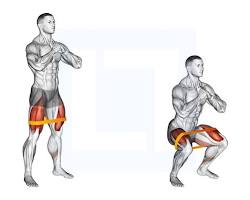
One of my NRHM patients suffered from chronic knee pain during traditional squats. By switching to “Banded Distraction” squats (where the band pulls the joint into a better position), we were able to strengthen the surrounding muscles without irritating the joint. Within 4 weeks, his pain levels dropped from an 8/10 to a 2/10.
THE RESULTS: What You Can Expect
- Days 1–7: Increased muscle “pump” and improved mind-muscle connection.
- Days 14–21: Noticeable improvements in posture and reduced “phantom” joint pains.
- Day 30+: A leaner physique and better magnesium-supported recovery scores.
TROUBLESHOOTING: Why You Aren’t Seeing Growth
- The Band is Too Light: If you can do 30 reps easily, the tension is too low to trigger a clinical response.
- Lack of Control: If the band “snaps” back on the way down, you are losing 50% of the workout. Control the eccentric.
- Poor Recovery: Muscle is built during rest. Ensure you are optimizing your sleep and mineral status.
FAQ
Q: Can bands really build as much muscle as weights?
A: For 90% of people, yes. While elite bodybuilders need heavy iron, bands provide enough tension to reach the “failure” point needed for muscle growth.
Q: Do bands snap?
A: Only if they are old or have nicks. Always inspect your bands before a session for tiny tears.
FINAL TAKEAWAY: Strength Anywhere
Strength is a biological necessity, not a luxury. By using resistance bands, you remove the excuse of “no space” or “no time.” You can build a resilient, metabolically active body in 20 minutes from a hotel room or a studio apartment. Combine this with a daily mobility flow to ensure your strength is matched by your movement
⚠️ Disclaimer
This article is intended for educational and informational purposes only. Exercise programs should be adapted to individual needs and abilities. Individuals with medical concerns or injuries should seek guidance from qualified healthcare professionals when appropriate.
📚 References
- National Institutes of Health (NIH)
- American College of Sports Medicine (ACSM)
- National Strength and Conditioning Association (NSCA)
- Harvard Health Publishing
- Cleveland Clinic
Additional background on resistance-band training and strength development:
Next Step: Find Your Metabolic Bottleneck
Are you a Stalled Optimizer or a Metabolic Warrior? Stop guessing and start signaling.
To find out which of your 4 biological pillars is stalling your progress, take our 2-minute diagnostic:
Take the 2026 Bio-Recovery AuditDiscover your score across the 4 Pillars of Performance: Engine, Armor, Cleanup, and Repair.