

Many people start exercising with an incredible amount of enthusiasm, only to find that their physical progress eventually slows down. They might faithfully execute the exact same workouts week after week, but over time, they stop seeing any visible improvements in their strength, overall fitness, or cardiorespiratory endurance.
This plateau can be deeply frustrating, often leading individuals to assume they simply lack the genetics for fitness or that their current routine is a complete failure.
In most cases, however, the root cause is much simpler: a lack of progressive overload. While it sounds like a clinical term reserved for sports scientists or competitive powerlifters, it is actually a beautifully straightforward concept that explains how the human body adapts to physical movement over time.
┌────────────────────────────────────────────────────────────────────────┐
│                        THE SEDENTARY STAGNATION LOOP                   │
├───────────────────────────────┬────────────────────────────────────────┤
│ 🔁 THE REPETITIVE WORKOUT     │ Same Routine ──► Body Becomes Efficient │
│                               │ ──► Plateau ──► No New Physical Gains  │
├───────────────────────────────┼────────────────────────────────────────┤
│ 📈 THE OVERLOAD PRINCIPLE     │ Step-by-Step Challenge ──► Biological   │
│                               │ Disruption ──► Adaptation ──► Progress │
└───────────────────────────────┴────────────────────────────────────────┘
Without a steady, structured increase in the demands placed on your tissues, your body has no biological reason to change. This guide breaks down the simple science of progressive overload, shows you how to apply it to any type of movement, and gives you a practical framework to ensure your consistency translates into long-term results.
What Is Progressive Overload?
Strip away the complex fitness magazine terminology, and the definition becomes remarkably clear: progressive overload simply means gradually increasing the physical challenge placed on your body over time so it continues to adapt and grow stronger.
Think of your body as an incredibly smart, highly responsive system. When you expose it to a physical challenge that it isn’t used to, it recognizes that challenge as a temporary stressor. To make sure that same stressor doesn’t catch it off guard next time, your body builds new physical adaptations—such as denser muscle tissue, stronger bones, or more efficient lung capacity.
                    ┌───────────────────────────────┐
                    │ PROGRESSIVE OVERLOAD LIFECYCLE│
                    └───────────────┬───────────────┘
                                    ▼
         ┌──────────────────────────┼──────────────────────────┐
         ▼                          ▼                          ▼
┌─────────────────┐        ┌─────────────────┐        ┌─────────────────┐
│ LIGHT DISRUPTION│        │ SYSTEMIC REPAIR │        │ INTEGRATION     │
│ Introduce a New │        │ Tissues Rebuild │        │ The Target Load │
│ Physical Demand │        │ Stronger        │        │ Is Now Easy     │
└─────────────────┘        └─────────────────┘        └─────────────────┘
You already experience this fundamental law of adaptation in your everyday life, well outside the walls of a traditional gym:
- Walking Farther: If walking a mile around your neighborhood leaves you breathing heavily on Monday, your body will adapt by the following month, allowing you to walk that same mile with absolute ease.
- Carrying Heavier Groceries: Carrying a heavy bag of soil or groceries across a parking lot forces your grip, arms, and core muscles to tighten and support the load, making future household chores feel much lighter.
- Completing More Movements: Doing a handful of repetitive movements—like climbing up and down your basement stairs—eventually becomes effortless as your lower body adapts to the regular mechanical work.
Progressive overload is simply the intentional, organized application of this natural adaptation process to your healthy movement routine.
Why the Body Adapts to Repeated Activity
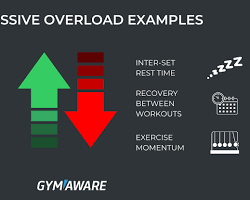
To make progressive overload work for you, it helps to understand the biological logic behind why your body adapts in the first place. At its core, the human body is designed for efficiency and survival. It constantly seeks to minimize energy expenditure and protect its internal balance.
When you perform a specific workout for the very first time, your muscles, nervous system, and cardiovascular systems are caught off guard. The movement feels challenging, your heart rate rises rapidly, and you might experience a moderate amount of muscle soreness over the next few days. This occurs because your body has to work exceptionally hard to overcome the unfamiliar physical stress.
Unfamiliar Workout Stress ──► Biological Disruption ──► Tissues Over-Repair ──► New Physical Baseline
However, as you repeat that exact same workout layout week after week, your body starts optimizing its response:
- Your nervous system learns how to coordinate your muscles with greater precision.
- your muscle fibers get more efficient at utilizing circulating cellular energy.
- Your heart and lungs learn to pump oxygen-rich blood with less overall effort.
Eventually, the workout that used to leave you exhausted feels completely easy. While this efficiency is fantastic for daily comfort, it means the movement is no longer disruptive enough to trigger new adaptations. If you want your body to continue building strength, improving bone density, or increasing cardiovascular health, you must introduce a new, slightly higher baseline challenge.
A Practical Observation About Consistency
Through my background in laboratory science and public health, I have often noticed that many people believe fitness results come from discovering a hidden, perfect workout routine or constantly shocking their system with complex, highly varied exercises.
We see a massive amount of marketing hype promising that changing your workouts every single day is the key to breaking plateaus and keeping your body guessing. However, population-level health data and structural exercise science paint a completely different picture.
[ Constant Routine Switching ] ──► Poor Skill Mastery ──► Stalled Long-Term Progress
[ Structured, Gradual Progression ] ─► High Skill Mastery ──► Lasting Physical Adaptation
In reality, long-term physical progression and lifestyle consistency matter infinitely more than constantly changing your routines. Your tissues do not adapt to random variety; they adapt to a consistent challenge that is gradually stepped up over time. Small, measured improvements repeated week after week can produce massive, meaningful long-term health results.
True public health utility comes from keeping things simple, accessible, and repeatable, ensuring that anyone can see continuous physical improvements using the basic tools they already have at home.
Signs You May Not Be Progressing
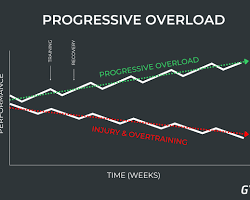
It is incredibly common to confuse “being active” with “progressing.” You can sweat, work hard, and burn energy during a workout, but if you do not consciously apply the principle of progressive overload, your baseline fitness parameters will remain completely unchanged.
Assessing Your Current Routine: Action vs. Progression
| Daily Routine Metric | Active but Stagnant Pattern | Structured Progressive Pattern |
| Weight Selection | • Utilizing the exact same $10\text{-lb}$ dumbbells for months. | • Moving from $10\text{-lb}$ to $12\text{-lb}$ weights as capacity improves. |
| Movement Counts | • Completing the same 10 repetitions every single session. | • Increasing from 10 to 12, then 15 reps over a few weeks. |
| Pace and Distance | • Walking the same 2-mile route in exactly $30\text{ minutes}$ every day. | • Gradually extending the route or completing it with more control. |
| Physical Effort | • The entire workout feels effortless and casual every time. | • The final few movements of a set feel moderately challenging. |
If your exercise routine feels identical to how it felt six months ago, your body has completely adapted to the load. To kickstart your progress and wake up those dormant physical adaptations, you need to introduce a new layer of challenge.
Five Simple Ways to Apply Progressive Overload
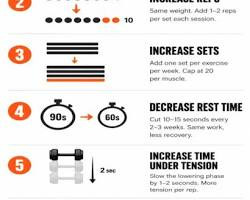
The beauty of progressive overload is that lifting heavier weights is only one way to challenge your body. There are five highly effective, beginner-friendly methods to introduce progression into your routine without requiring a gym full of heavy equipment.
The Fundamental Progression Methods
                  ┌──────────────────────────────────────────────┐
                  │      THE PROGRESSIVE OVERLOAD TOOLKIT        │
                  └──────────────────────┬───────────────────────┘
                                         │
     ┌───────────────────┬───────────────┴───┬───────────────────┬───────────────────┐
     ▼                   ▼                   ▼                   ▼                   ▼
┌──────────────┐   ┌──────────────┐   ┌──────────────┐   ┌──────────────┐   ┌──────────────┐
│ RESISTANCE   │   │ REPETITIONS  │   │ TOTAL SETS   │   │   DISTANCE   │   │   QUALITY    │
│ Heavier Load │   │ Higher Count │   │ More Rounds  │   │ Longer Range │   │ Control/Form │
└──────────────┘   └──────────────┘   └──────────────┘   ┌──────────────┘   └──────────────┘
1. Increase the Resistance
This is the most traditional approach. If a specific weight or resistance level begins to feel light, you make the movement more challenging by adding a small amount of extra load.
- Everyday Example: Moving from a pair of $8\text{-lb}$ dumbbells to $10\text{-lb}$ dumbbells, or shifting to a thicker, stiffer resistance band for your home exercises.
2. Increase the Repetitions
If you do not have access to heavier weights, you can easily progress by increasing the number of times you complete the movement within a single turn, known as repetitions or reps.
- Everyday Example: If you usually complete 10 bodyweight squats before resting, try pushing yourself to complete 12 squats next week, and 15 squats the week after that.
3. Increase the Total Sets
A set is simply a group of repetitions. If you aren’t ready to add more reps to a single set, you can increase your total workload by adding an extra round of the exercise to your overall workout.
- Everyday Example: If your routine consists of doing 2 rounds of 10 lunges, you can step up the challenge by performing 3 total rounds of 10 lunges, giving your body more total movement to adapt to.
4. Increase the Distance or Time
This strategy is an exceptional tool for walkers, runners, cyclists, and swimmers. You progress your training volume by gradually expanding the physical distance you cover or extending the total time you spend moving.
- Everyday Example: If you currently walk for $15\text{ minutes}$ after your midday meal, try extending that walk to $20\text{ minutes}$ next week to build better cardiorespiratory endurance.
5. Improve Your Exercise Quality and Control
This is one of the most powerful yet frequently forgotten methods of progression. You can make an exercise significantly more challenging without changing the weights or the reps simply by performing the movement with better structural form, slower speed, and a greater range of motion.
- Everyday Example: Instead of rushing through your bodyweight squats using momentum, lower yourself down slowly over 3 full seconds, pause briefly at the bottom, and stand back up under absolute skeletal control.
To explore how improving your movement quality and mechanics can protect your joints and build long-term mobility, explore FitBodySync’s Structural Guide to Why Leg Strength Matters.
Progressive Overload Isn’t Just for the Gym
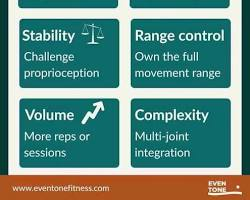
A common myth in fitness culture is that progressive overload only applies to bodybuilders or people lifting heavy barbells inside a commercial gym. In truth, this principle is a universal law of human biology that can be applied to any form of physical movement.
  Outdoor Walking ────► Progress by adding 5 extra minutes or choosing a hillier path
  Bodyweight Shifts ──► Progress by slowing down your movements or increasing reps
  Daily Activities ───► Progress by carrying household items with better posture
- Casual Walking: You can smoothly progress a daily walking habit by tracking your steps and adding an extra 500 steps to your daily goal each week, or by choosing a path that incorporates a few moderate hills to challenge your lower body.
- Home Bodyweight Exercises: Basic home movements like wall push-ups, chair squats, or floor glute bridges can all be progressed by adjusting your body angles, slowing your tempo, or adding brief pauses at the hardest part of the movement.
- Daily Activity: Even your normal chores can benefit from gradual progression. Carrying two bags of mulch instead of one, or walking a little faster during your daily errands, provides a healthy, low-impact stimulus to your musculoskeletal system.
Common Mistakes to Avoid
While applying progressive overload is highly effective, it is vital to approach it with a mindset of patient, long-term safety. Watch out for these common beginner pitfalls:
- Doing Too Much Too Quickly: Trying to lift vastly heavier weights, double your walking distance, or add massive amounts of workout sets from one week to the next is a recipe for physical exhaustion and joint strain. Progress should always be a gentle, step-by-step staircase, not a massive leap.
- Comparing Your Journey to Others: Everyone’s biological adaptation rate is completely unique, heavily influenced by age, sleep quality, stress levels, and exercise history. Focus entirely on your own data and celebrate your personal step-by-step improvements.
- Completely Ignoring Your Recovery: Progressive overload only works if your body is given the time and resources to repair the controlled stress you place on it. If you add more challenge to your workouts while skimping on sleep and rest, your performance will quickly drop.
- Changing Your Workout Routine Every Week: If you switch your exercises every single session, your nervous system never has the chance to master the movements, making it nearly impossible to measure true structural progress over time. Pick a handful of basic movements and stick with them for at least $4\text{ to }6\text{ weeks}$.
A Practical Beginner Progression Example
To see how simple and achievable this concept is in practice, look at this balanced, 4-week progression template for a beginner performing basic home bodyweight squats. Notice how the workout changes slightly every week to keep the body adapting safely.
The FitBodySync 4-Week Bodyweight Squat Blueprint
📅 WEEK 1: BUILDING THE BASELINE
└── Workout Layout: 2 Sets of 10 Repetitions
    └── Focus: Learning the movement pattern and ensuring comfortable joint mechanics.
        └── Total Volume: 20 total squats completed across the session.

📅 WEEK 2: CHALLENGING YOUR ENDURANCE
└── Workout Layout: 2 Sets of 12 Repetitions
    └── Focus: Keeping the exact same form but adding 2 extra reps to each round.
        └── Total Volume: 24 total squats (A safe, 20% increase in workload).

📅 WEEK 3: INCREASING SYSTEMIC VOLUME
└── Workout Layout: 3 Sets of 10 Repetitions
    └── Focus: Returning to 10 reps, but adding a 3rd round to increase muscle time-under-tension.
        └── Total Volume: 30 total squats completed across the session.

📅 WEEK 4: INTRODUCING GENTLE RESISTANCE
└── Workout Layout: 2 Sets of 10 Repetitions with a Light Load
    └── Focus: Dropping back to 2 sets of 10, but holding a light household object (like a water jug).
        └── Total Volume: 20 total squats with an added mechanical challenge.
By the end of this 4-week cycle, your lower-body muscles and nervous system will be significantly stronger and more resilient than they were on day one—all achieved through tiny, highly manageable weekly adjustments.
To understand how to recognize if your body is adapting smoothly or if you are pushing your progression steps too fast, read FitBodySync’s Guide to the 7 Signs You Need More Recovery.
Why Small Improvements Matter for Lifetime Fitness
In a world that constantly demands instant gratification and dramatic overnight transformations, it is vital to remember that true, lasting physical health is built on a foundation of patience and small, incremental habits.
[ Chasing Massive, Sudden Gains ] ──► High Risk of Injury, Frustration, & Quitting
[ Accumulating 1% Weekly Gains ] ───► Lasting Bone Density, Joint Health, & Longevity
You do not need to make massive, heroic leaps in your workouts to achieve a resilient body. Focusing on making a tiny, $1\%$ improvement each week—whether that means performing one extra repetition, walking for two additional minutes, or moving with slightly better control—creates a powerful compounding effect over time.
These small, sustainable steps keep your exercise routine thoroughly enjoyable, protect your joint health, and smoothly integrate into your daily life, building a strong foundation for lifelong physical independence.
To find out how a simple, low-impact habit like walking can support your daily energy clearing without adding workout stress, explore FitBodySync’s Guide to Post-Meal Walking for Metabolic Fitness.
Frequently Asked Questions (FAQ)
1. What is the simplest way to define progressive overload for a total beginner?
Progressive overload simply means making your physical activities slightly more challenging over time—by adding a little more weight, performing a few more repetitions, or moving for a slightly longer duration—so your body can continue to adapt and grow stronger.
2. How frequently should I try to increase the difficulty of my workouts?
For most beginners, evaluating your progress every $1\text{ to }2\text{ weeks}$ is an exceptional cadence. Only step up the challenge when your current workout feels completely comfortable and your form is absolutely flawless. Never sacrifice safety for a faster progression.
3. Can individuals who are completely new to fitness safely use progressive overload?
Absolutely. In fact, beginners stand to gain the most from this concept. Starting with very light, comfortable movements and making tiny, step-by-step weekly adjustments is the safest, most effective way for a beginner to build physical resilience.
4. Does a casual walking routine utilize the principle of progressive overload?
Yes. You can smoothly progress a daily walking habit by adding a few extra blocks to your route, walking for an additional five minutes, or trying to complete your standard distance with greater postural control.
5. Can I apply progressive overload effectively if I don’t have a gym membership?
Without a doubt. You can easily progress your home workouts by adding more repetitions, increasing your total rounds, slowing down your movement speed, or utilizing simple household items like water jugs or backpacks for gentle resistance.
Conclusion
Progressive overload may sound like a highly technical concept, but the underlying idea is wonderfully simple, intuitive, and accessible to anyone. It is the biological blueprint that allows our bodies to transform physical effort into long-term strength, mobility, and vitality.
Stepping away from the frustrating cycle of repeating the exact same unchallenging workouts allows you to unlock your body’s true potential for adaptation. Whether you are expanding your daily outdoor walks by a few minutes, adding a couple of repetitions to your home bodyweight exercises, or improving your movement control, making small adjustments consistently ensures your efforts yield real results.
By prioritizing patient, step-by-step progress over extreme, short-term fatigue, you protect your joints, maintain your motivation, and build a capable, resilient body that supports your physical freedom for years to come.
Disclaimer: The information provided in this article is for educational and informational purposes only and is not intended as medical or professional health advice. Always consult with a qualified healthcare professional or physician before beginning any new exercise routine, increasing physical activity levels, or altering your training volume, especially if you are returning to exercise after a period of inactivity.
References
- American College of Sports Medicine (ACSM): Position Stand on Progression Models in Resistance Training for Healthy Adults and Lifelong Fitness Preservation
- National Strength and Conditioning Association (NSCA): The Core Principles of Mechanical Overload, Muscular Adaptation, and Exercise Program Design
- Centers for Disease Control and Prevention (CDC): Physical Activity Resources for Building Long-Term Musculoskeletal Health and Lifetime Habit Consistency
- World Health Organization (WHO): Global Recommendations on Physical Activity and the Importance of Gradual Load Progression for Joint Resilience
Next Step: Find Your Metabolic Bottleneck
Are you a Stalled Optimizer or a Metabolic Warrior? Stop guessing and start signaling.
To find out which of your 4 biological pillars is stalling your progress, take our 2-minute diagnostic:
Take the 2026 Bio-Recovery AuditDiscover your score across the 4 Pillars of Performance: Engine, Armor, Cleanup, and Repair.